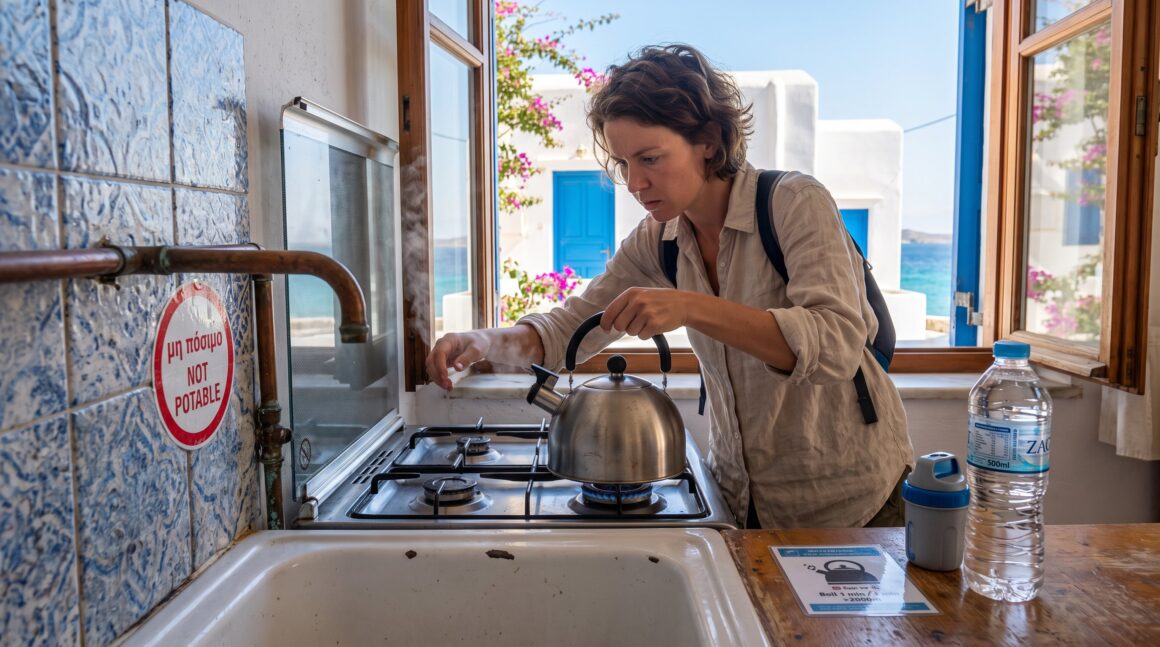
Can you drink boiled tap water in Greece is a question many travelers ask on arrival. The short answer: yes in most mainland cities, but caution is needed on many islands and small villages. This guide gives clear, actionable rules, exact boiling times, real risks (salinity, chemicals, old pipes), and practical alternatives so readers can decide quickly and safely.
Key Takeaways
- Boiled tap water in Greece is generally safe to drink in mainland cities like Athens and Thessaloniki, where water meets EU standards.
- Boiling tap water kills microbes but does not remove salts, heavy metals, or chemical contaminants common on many islands and small villages.
- Always avoid drinking tap water marked with ‘μη πόσιμο’ (not potable), even if boiled, to prevent exposure to harmful chemicals.
- For reliable safety, travelers should boil tap water for at least one minute at sea level and store it in clean, covered containers to avoid recontamination.
- On islands with salty or questionable water sources, bottled or reverse osmosis filtered water is recommended over boiled tap water for regular consumption.
- Asking local hosts about tap water usage and checking signs can help travelers decide when boiled tap water in Greece is safe or when alternatives are necessary.
Quick Answer: Is Boiled Tap Water Safe In Greece?
Yes and no, the safety of boiled tap water in Greece depends on location and water source. In Athens, Thessaloniki, and most large urban systems, tap water meets EU standards and is already potable: boiling is usually unnecessary and serves only as an extra safety margin for very cautious visitors. On many islands and small villages, municipal supplies often rely on desalination, seasonal shipments, or older local wells. There, tap water may not be recommended for regular drinking. Boiling in those places kills microbes but does not remove salt, heavy metals, or chemical contaminants.
Concrete rules: if a tap or sign displays “μη πόσιμο” (not potable), do not drink the water even after boiling. If locals routinely drink the tap and it tastes normal, boiled tap water in Greece is generally safe on the mainland. When in doubt, prefer bottled or filtered water for daily drinking on islands.
What’s In Greek Tap Water? Common Contaminants And Quality Standards
Greek municipal water in big cities is treated and monitored under the EU Drinking Water Directive, managed by agencies like EYDAP (Athens) and EODY. Typical inputs: chlorine residuals for disinfection, mineral hardness (calcium and magnesium), and low levels of regulated metals within legal limits. Problems that occur repeatedly: elevated hardness (one sample can measure >300 mg/L as CaCO3 in hard zones), occasional taste issues from chlorine spikes, and microplastic traces reported in some studies.
On islands, sources vary: desalinated seawater, trucked water, or shallow wells. Desalinated water can carry higher sodium levels, a visitor measured salty taste at 120–300 mg/L sodium in some island supplies (example figure). Old building pipes may leach lead or copper in rare cases, especially in private plumbing older than 30 years. Authorities publish periodic reports: travelers who want certainty can check the local municipality report or ask accommodation hosts for recent water quality results.
Boiling Water: What It Removes And What It Doesn’t
Fact first: boiling kills pathogens but does not remove dissolved chemicals or salts. When a traveler boils tap water in Greece, a rolling boil for one minute (three minutes above 2,000 meters) reliably inactivates bacteria (e.g., E. coli), viruses (e.g., norovirus), and most protozoa (e.g., Giardia). That is why boiling fixes microbiological risk after short-term contamination or uncertain supplies.
What boiling does not do: it cannot remove sodium, nitrates, heavy metals (lead, arsenic), microplastics, or volatile organic compounds. Boiling may concentrate these contaminants as water volume reduces by evaporation. For example, if water contains 50 mg/L sodium, boiling to reduce volume raises that concentration proportionally. Chemical hazards require alternative treatments: reverse osmosis, carbon-plus-RO filtration, or switching to bottled water certified for low mineral content.
When Boiling Is Sufficient — And When It’s Not
Boiling works when the primary concern is microbes. Practical scenarios where boiling is sufficient:
- A small village reports occasional gastroenteritis but no chemical advisory. Boiling tap water for 1 minute before drinking or using it for hot drinks prevents infection.
- A traveler needs safe water for tea, coffee, or cooking on an island where municipal water is microbiologically variable but tastes normal.
When boiling is insufficient:
- If a water source has high salinity (salty taste) from desalination or seawater intrusion, boiling won’t fix taste or sodium content.
- Where authorities post a “not potable” sign (μη πόσιμο) due to chemical contamination or unknown risks, boiling is not a safe solution.
- When heavy metals or persistent organic pollutants are suspected (older plumbing, industrial runoff), only certified filtration (RO or targeted media) or bottled water solves the problem.
Practical warning: in places with intermittent supply and visible pipe work, even boiled water can be recontaminated by storage in dirty containers. Clean storage matters.
Boiling For Travelers: Practical Tips (How Long, Storage, And Cooling)
Boil first: bring water to a rolling boil for at least 1 minute at sea level: at elevations above 2,000 meters, boil for 3 minutes. After boiling, remove from heat and let it cool naturally, do not add ice made from questionable water. Pour directly into a clean, covered thermos or bottle to avoid airborne contamination.
Storage guidance: use sterile or thoroughly cleaned containers (dish soap + hot water, rinse well). Store boiled water away from sunlight and use within 24 hours for drinking to limit bacterial regrowth: use within 48–72 hours for cooking if refrigerated. Label containers with the boil date and time if staying multiple days.
Traveler tip: when staying in rental accommodation, ask hosts if tap water is routinely consumed. If they say yes, boiled tap water in Greece is usually fine for short stays on the mainland. If they say no, assume bottled or filtered water is the safer choice.
Alternatives To Boiling: Filtration, UV Purifiers, And Bottled Water
Alternatives often combine convenience and targeted removal.
-
Filters: Activated carbon filters improve taste and remove chlorine and some organic compounds: combined micro/ultrafiltration removes bacteria and protozoa. Reverse osmosis removes salts, most metals, and many chemicals, ideal for island desalination issues but requires a system or reliable bottled-RO brands. Example: a travel filter with 0.1 micron pore size typically removes bacteria and protozoa but not dissolved salts.
-
UV purifiers: Devices like SteriPEN inactivate viruses and bacteria quickly. They require clear water (low turbidity) and do not remove chemicals or salts.
-
Bottled water: Widely available across Greece: choose brands that list mineral content if sodium or hardness is a concern. Bottled water is the default recommendation for daily drinking on many islands and in uncertain village systems. For sustainability, refill from verified public refill stations in big cities where tap water is safe.
Practical comparison: on an island with salty-tasting tap water, bottled RO water or a portable RO/CO2 combo is the only practical fix for repeated drinking.
Conclusion
Boiled tap water in Greece is a reliable microbial safeguard on the mainland and in many urban centers. On islands and in small villages, boiling helps for microbes but does not solve salty taste, chemicals, or old-pipe metal leaching. Travelers who want zero uncertainty should use bottled or certified filtration (RO or appropriate combo). Simple habits, ask hosts, check local signage, boil correctly, and store water cleanly, cut risk and keep trips smooth.