
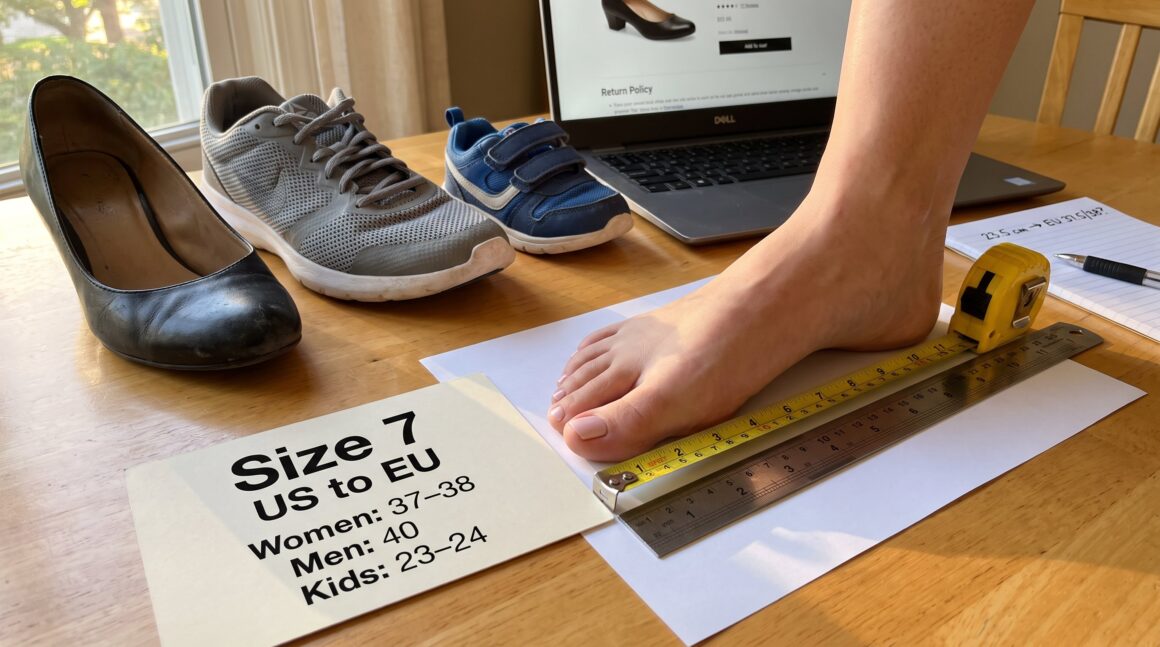
Size 7 US to EU conversions cause confusion for shoppers, designers, and resellers. This guide gives clear conversions, concrete measurements, and brand-aware advice so readers pick the right shoe. It highlights women’s, men’s, and kids’ differences, shows how to measure foot length in centimeters, and lists practical online buying checks to avoid painful returns.
Key Takeaways
- Understanding size 7 US to EU conversions is essential as women’s, men’s, and kids’ sizes differ significantly, with women’s US 7 typically matching EU 37–38 and men’s US 7 around EU 40.
- Measuring your foot length in centimeters and consulting the specific brand’s size chart ensures the most accurate size 7 US to EU conversion and better fit.
- Always consider shoe type, width, and brand-specific sizing nuances since EU sizes reflect length but can vary due to lasts and brand design.
- When buying size 7 US shoes online, verify the category (men’s, women’s, youth), use the brand’s centimeter charts, and read customer reviews to avoid returns.
- Allow extra room for thicker socks, foot expansion, and children’s growth by selecting slightly larger EU sizes or half sizes when measurements fall between sizes.
- Keeping a record of your foot measurements linked to brand and model helps prevent repeat fitting mistakes and simplifies future size 7 US to EU conversions.
Understanding Shoe Size Systems: US, EU, UK, And International Differences
Fact: shoe sizing uses at least three different scales, US, EU, and UK, that don’t map one-to-one. The US system separates men’s and women’s numbers, the UK scale runs about one size smaller than US for many adults, and the EU uses a continuous length-based scale (often called Paris points).
Why it matters: a US 7 in women’s sizing is not the same as a US 7 in men’s: the EU number that matches depends on the chart and brand. For example, many conversion references place a women’s US 7 around EU 37–38, while men’s US 7 commonly appears as EU 40. Those numbers come from aggregated brand charts and foot-length approximations and work as starting points, not guarantees.
A quick practical note: EU sizing often reflects last length or foot length in centimeters multiplied by a factor, so two brands using the same EU number can still fit differently. Brands also sell narrow or wide lasts and may shift a nominal size by half a size. Retailers that treat size purely as a label create returns: brands that manage naming and sizing carefully reduce them. That naming discipline is part product design and part brand management, and firms that invest in consistent sizing see fewer customer fit complaints, a point discussed in broader brand strategy literature What Hailey Bieber Can Teach Us About Brand Management.
How A Size 7 US Converts To EU For Women, Men, And Kids
Fact: a single numeric “7” in the US system splits into different EU numbers by category. Use category-specific charts, measure in centimeters, and expect brand variation.
Conversion overview: common reference mappings are: women’s US 7 ≈ EU 37–38, men’s US 7 ≈ EU 40, and kids’ US 7 varies widely by age group and brand. These conversions reflect aggregated industry charts and the practical reality that EU sizing follows a length scale rather than gendered labels. Below are precise, category-specific notes and fit considerations to help shoppers pick the right EU number.
Women: Size 7 US To EU Conversion And Typical Fit Considerations
Fact: women’s US 7 typically converts to EU 37 or EU 37.5–38 depending on the brand and the last.
Context and numbers: many European-brand charts list US women’s 7 as EU 37, while some American brands that translate foot length prefer EU 37.5 or 38 to account for slightly longer lasts. For shoppers: measure heel-to-toe length and compare the result to the brand’s centimeter chart. Example, a foot measuring 23.5 cm often corresponds to EU 37.5 on several popular charts, making EU 37 feel tight and EU 38 a slightly roomy but safer choice for thicker socks.
Fit considerations: women with high insteps should favor the larger EU number or seek half sizes. If a brand offers narrow and regular widths, a measured 23.5 cm foot in a narrow last may still need EU 37. For dress shoes that run firm, many shoppers choose the higher EU value and rely on insoles for micro-adjustments.
Vulnerable moment: one buyer ordered an EU 37 from a clean-looking online shop and couldn’t fit her toes into the toe box, she learned to always check the centimeters and the return window. Practical warning: never assume the same EU number fits all shoe types: heels, boots, and sneakers fit differently even in the same brand.
Men: Size 7 US To EU Conversion And How It Differs From Women’s Sizing
Fact: men’s US 7 most commonly maps to EU 40 on standard charts.
Numbers and rationale: the men’s scale places US 7 near EU 40 because men’s US sizes start at a different baseline and use a different increment. A typical conversion rule used by many retailers: add 33 to the US men’s size to approximate EU (7 + 33 ≈ 40). That shortcut is a quick check but not a replacement for measuring.
Fit details: men’s shoes with the EU 40 label can vary by last and purpose. Athletic shoes often include extra room for foot expansion during activity: a men’s US 7 runner labeled EU 40 may feel roomier than a dress shoe labeled the same. Men who are between widths or have wide forefeet should round up or look for wide-specific models.
Real example: a man with feet measuring 25.5 cm ordered EU 40 sneakers and found a half-size gap in a brand known for generous toe boxes. Lesson: measure, compare to the brand’s centimeter chart, and read recent fit reviews for that model.
Kids: Converting Youth And Toddler Size 7 US To EU
Fact: a kids’ US size 7 can mean different EU numbers depending on whether it’s toddler, preschool, or youth sizing. There is no single EU equivalent.
Concrete breakdown: in toddler sizing, US 7 often corresponds roughly to EU 23–24. In youth (older children), a US 7 may appear as EU 40 in some unisex charts, but that is rare and typically tied to teen/adult overlaps. Because children’s feet grow rapidly, brands prefer age-based charts or centimeter measures: many manufacturers publish a simple foot-length-to-EU conversion for each age group.
Practical scenario: a parent measured their child’s foot at 15 cm. The brand’s toddler chart mapped 15 cm to EU 24. The parent bought EU 24 and left 1 cm growth room: the shoes fit snugly at the heel but allowed toe growth. Warning: buying by the printed US number alone led to multiple returns for that parent until they switched to centimeter-based sizing.
Tip: for children, always leave 0.8–1.2 cm of wiggle room for growth and movement.
Measuring Your Foot And Using Size Charts For A Reliable Size 7 Conversion
Fact: the most reliable way to convert a size 7 US to EU is to measure foot length in centimeters and consult the brand’s chart.
Step-by-step measurement: stand on a sheet of paper, trace the heel and longest toe while wearing the socks you will use with the shoe, and mark the two outermost points. Measure the distance with a ruler to the nearest 1 mm. Repeat for both feet and use the longer measurement.
How to use the number: compare that centimeter value to the brand’s chart to find the EU equivalent. Example: if the longer foot measures 24.0 cm, many brand charts place that at EU 38–39 for women’s styles or EU 40 for men’s athletic styles: always check the specific brand’s centimeter row.
Concrete numbers and advice: measure twice and on a time of day when feet are swollen slightly (late afternoon), feet expand 0.3–0.7 cm during the day for many people. If the measurement lies between two EU entries, pick the larger one for comfort or if the shoe has limited stretch. Record your measurements in a small note tied to the brand and model for future purchases.
Tips For Buying Size 7 US Shoes Online, Common Pitfalls, And Fit Troubleshooting
Fact: most online returns for shoes happen because shoppers ignored brand charts, width options, or the product-specific fit notes.
Top practical tips:
- Always check whether the listing is for men’s, women’s, or youth sizing: a mislabeled category will produce bad fit.
- Use the brand’s centimeter chart, not a generic conversion table, and compare your measured length to the chart.
- Read recent customer reviews for the specific model: reviewers often state “runs small” or “true to size.”
Common pitfalls: relying on a single conversion table, failing to account for sock thickness, and overlooking width. For example, a buyer assumed women’s US 7 = EU 37 and ordered flats, but the brand’s last ran narrow: the fix required returning them. Practical troubleshooting steps: if shoes feel tight at the toe, try a half size up or a different last: if heel slips, add a heel grip or thin insole.
Return policy checklist: confirm free returns, measure both feet before ordering, and allow 0.5–1.0 cm growth margin for children. When in doubt, contact customer service and ask for the shoe’s internal length in cm.
Final caution: brand-specific shifts happen, and shoppers who keep a simple note of past purchases (brand, model, measured fit) avoid repeating mistakes.