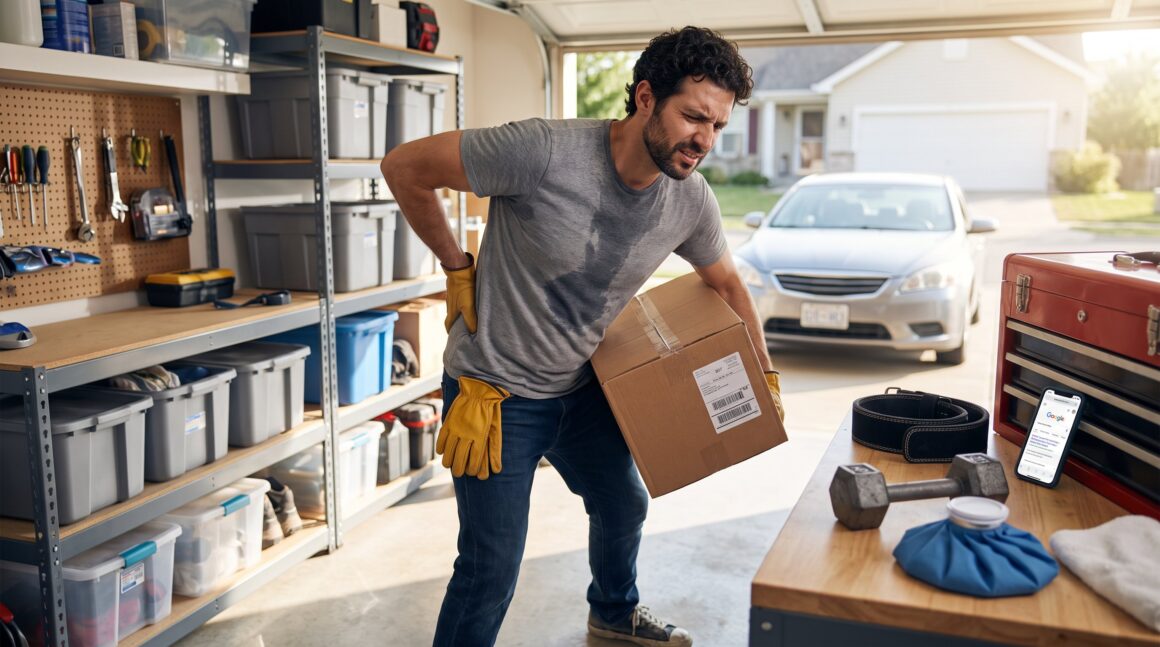
σηκωσα βαρος και ποναει η μεση μου, this phrase captures the immediate alarm someone feels after a sudden lifting pain. Readers who search that Greek phrase want fast, clear answers. This guide explains why the lower back hurts after lifting, what to do in the first 48 hours, a step-by-step at-home recovery plan, how to prevent a repeat, and when to see a clinician. The advice is practical, evidence-informed, and written so someone can act right away and avoid common recovery mistakes.
Key Takeaways
- Lower back pain after lifting usually results from muscle strain or ligament overload, not severe injury, and often improves with proper care.
- Immediately stop heavy lifting and avoid movements that increase pain to speed recovery when experiencing lower back pain after lifting.
- Apply ice for the first 48 hours to reduce inflammation, then switch to heat if stiffness persists, and avoid prolonged bed rest to promote healing.
- Follow a phased 4-week at-home recovery plan focusing on gentle mobility, core and glute strengthening, and gradual return to daily activities.
- Prevent future episodes by improving lifting technique, strengthening the core and posterior chain, and optimizing posture and ergonomics during daily tasks.
- Seek urgent medical attention if you experience leg weakness, numbness, or loss of bladder or bowel control, as these are serious red flags.
Why Your Lower Back Hurts After Lifting: Common Causes And Red Flags
Fact first: most lower-back pain after lifting is a muscle strain or ligament overload, not a catastrophic injury. When someone says “σηκωσα βαρος και ποναει η μεση μου,” the likely causes are lumbar muscle strain, sudden awkward posture, twisting while lifting, or simply lifting too much weight without warm-up.
Context and specifics: a lumbar strain usually produces a sharp, localized ache that increases with bending or standing. If the person felt a specific pop or sharp stab at the moment of lifting, the strain is more likely. Weak hip or core muscles are common contributors: studies show weak glute and transverse abdominis activation increases lumbar load during lifts. Fatigue also raises risk, after 10–15 minutes of repeated heavy lifting, control drops and form falters.
Red flags to watch for: if pain radiates below the knee, causes leg numbness, tingling, or progressive weakness, or follows a fall, these signs may indicate a disc problem or nerve compression. Immediate medical evaluation is warranted for leg weakness, loss of bowel or bladder control, or constant severe, worsening pain. Those symptoms are rare but require urgent attention.
Immediate Steps To Take Right After The Injury (First 48 Hours)
Answer first: stop the activity, protect the spine, and move gently as pain allows. When someone thinks “σηκωσα βαρος και ποναει η μεση μου,” the first actions determine how quickly recovery starts.
Practical checklist for the first 48 hours:
- Stop heavy lifting and avoid bending and twisting that provoke pain.
- Lie down in a position that eases pain, on the back with knees bent or on the side with a pillow between knees. Those postures reduce lumbar load.
- Use ice for the first 24–48 hours if there is a sharp, hot pain: apply ice 15–20 minutes every 1–2 hours. Switch to heat after 48–72 hours if stiffness persists: heat increases blood flow and eases tight muscles.
- Take over-the-counter analgesics as needed and as appropriate for the individual (acetaminophen or NSAIDs) following dosing instructions.
- Avoid prolonged bed rest. Short periods (an hour or two) are okay, but staying immobile more than 24–48 hours slows recovery and increases stiffness.
Warning: if pain is worsening even though rest, or there is new numbness or weakness, seek medical attention right away. Conservative care helps most strains, but early red flags change the plan.
At-Home Recovery Plan: Pain Relief, Mobility, And Safe Return To Activity
Immediate answer: follow a progressive plan that balances pain control, gentle mobility, and staged activity. For someone searching “σηκωσα βαρος και ποναει η μεση μου,” a 4-week at-home protocol often restores function.
Week 1, Protect and restore movement:
- Day-to-day goal: reduce sharp pain and restore pain-limited walking. Walk 10–15 minutes several times daily if tolerable: walking reduces stiffness and promotes healing.
- Mobility drills: pelvic tilts (10–15 reps, twice daily) and knee-to-chest stretches (gentle, hold 20–30 seconds). These moves reduce muscle guarding without stressing discs.
- Pain control: continue ice or heat as needed and short-term meds if appropriate.
Weeks 2–3, Rebuild tolerance and strength:
- Add low-load core activation: dead-bug progressions, bird-dog holds (3 sets of 8–12 slow repetitions). These exercises teach the spine to move while the core supports it.
- Glute activation: 3 sets of 10 glute bridges and standing hip extensions. Stronger glutes shift load away from the lumbar spine.
- Gradual return to daily tasks: carry light groceries and avoid heavy lifts until pain-free during repeated lifting motions.
Weeks 4+, Return to full activity safely:
- Progressive loading: increase weight by no more than 10% per week and prioritize hip-hinge form.
- Conditioning: 20–30 minutes of cardiovascular exercise 3 times weekly supports tissue recovery and reduces recurrence risk.
Practical note: avoid ballistic twists, deep forward bends under load, and unbraced heavy lifting during recovery. If pain rises more than 2 points on a 0–10 scale after activity, scale back.
Exercises, Posture Fixes, And Ergonomics To Prevent Recurrence
Key insight first: prevention focuses on form, strength, and predictable progressions. After an episode captured by “σηκωσα βαρος και ποναει η μεση μου,” targeted changes prevent future flare-ups.
Exercises that work: prioritize hip-hinge mechanics and posterior chain strength. Practice the Romanian deadlift pattern with a dowel first: hinge at the hips, keep a neutral spine, and feel tension in the hamstrings. Perform 2–3 sets of 8–12 reps with light resistance, twice weekly. Add single-leg Romanian deadlifts and weighted carries to improve stability under load.
Core routine: train bracing not bulking. Planks (3 sets of 20–60 seconds) and side planks (3 sets of 20–40 seconds) build endurance. Progress to loaded carries (farmers carry) to teach the core to stabilize while moving.
Posture and daily ergonomics: set chair height so hips sit slightly above knees, avoid slumping, and use a lumbar roll for long sitting. When lifting, use the legs and hips: squat or hinge, keep the load close, and avoid twisting while lifting. A simple cue: “hips back, chest up, knees soft.”
Workplace adjustments: for office workers, stand for 5–10 minutes every hour, use a sit-stand desk if available, and keep frequently used items within arm’s reach to avoid repeated twisting.
Real-world metric: one study showed a 30–40% lower recurrence in people who adopted a structured strengthening and ergonomic plan versus those who did not. That kind of number matters when the goal is long-term resilience.
When To See A Doctor, When To Seek Urgent Care, And What To Expect
Clear rule first: seek urgent care for leg weakness, progressive numbness, or loss of bladder/bowel control. Those features suggest nerve compression or cauda equina syndrome and need immediate evaluation.
When to schedule a non-urgent doctor visit:
- Pain persists beyond 4–6 weeks even though conservative care.
- Pain severely limits daily tasks like dressing, walking, or working.
- Recurrent episodes happen with similar triggers.
What clinicians will do and why it matters:
- History and exam check for red flags, neurological deficits, and functional limitations. The clinician will test reflexes, strength, and sensation in the legs to assess nerve involvement.
- Imaging is not routine early on. X-rays or MRI are reserved for progressive neurological signs, suspicion of fracture, or planning for interventions. Most soft-tissue strains improve without imaging.
- Treatment options include prescription anti-inflammatories, physical therapy with graded loading, steroid injections for certain nerve-root pains, or surgical referral only for confirmed structural problems with neurological compromise.
Patient expectations: most uncomplicated strains improve within 4–6 weeks with the plan described above. If symptoms suggest a disc herniation with significant leg symptoms, physical therapy and targeted interventions often yield improvement over weeks to months. Honest assessment: surgery is rarely needed and usually reserved for persistent, severe nerve problems.
Conclusion
Actionable takeaway: when someone types “σηκωσα βαρος και ποναει η μεση μου,” the immediate steps are clear, stop heavy lifting, protect the spine, use brief ice or heat, and begin pain-limited movement. Follow a 3–4 week staged recovery that rebuilds mobility and strength, then improve lifting form and ergonomics to prevent repeats. Seek urgent care for leg weakness, numbness, or loss of bladder/bowel control. With sensible care and progressive loading, most people return to normal activity within weeks, not months.