
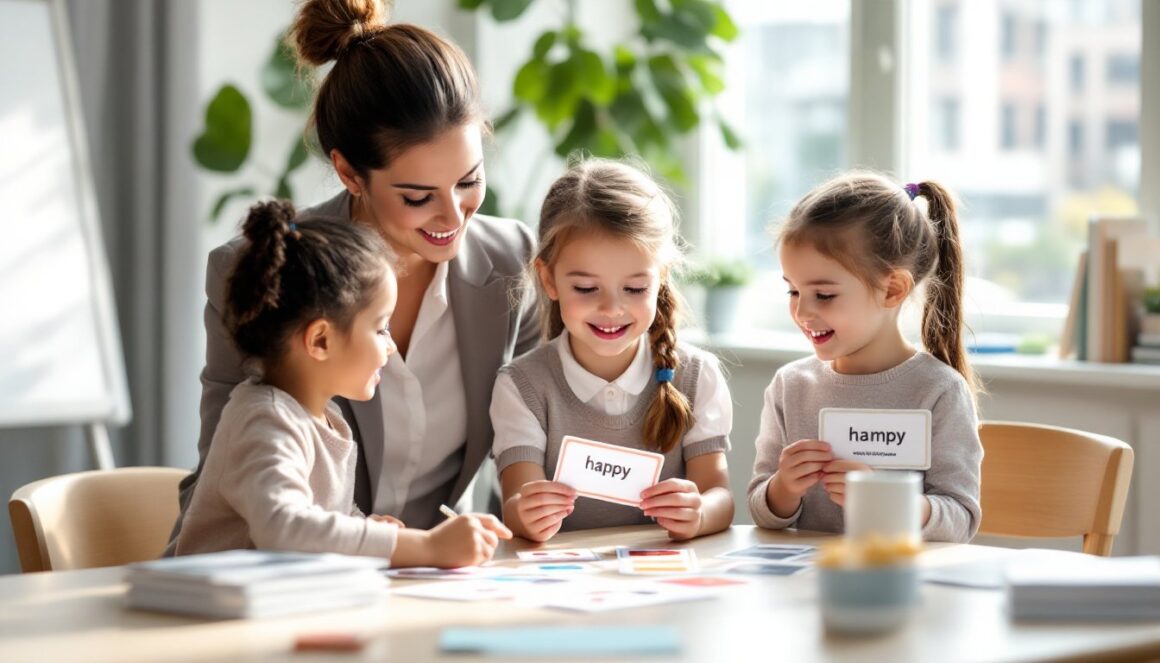
Teaching emotions visually helps children turn something abstract into something they can point to, name, and talk about. Whether a parent, teacher, or caregiver, selecting the right set of emotion images, or εικονες με συναισθηματα για παιδια, makes the difference between a confusing activity and a breakthrough moment. This guide explains why these images matter, which types work best at different stages, practical activities to try at home or in class, and how to choose images with confidence so kids actually learn, not just look at pictures.
Key Takeaways
- Using εικονες με συναισθηματα για παιδια helps children visually identify and name emotions, boosting their emotional vocabulary and expressive language skills.
- Start with simple images showing basic emotions like happy, sad, angry, and scared before introducing more nuanced feelings to support gradual learning.
- Choose culturally relevant emotion images with clear facial expressions and minimal distractions to improve recognition and engagement.
- Pair emotion images with words, facial expressions, and real-life scenarios to deepen understanding and encourage storytelling and problem-solving skills.
- Incorporate interactive activities like naming, story creation, matching, and charades to reinforce emotional recognition and regulation in a fun, memorable way.
- Observe children’s responses to adjust the complexity of emotion images and activities, ensuring effective learning and emotional development.
Why Emotional Images Matter For Children’s Development
Children learn much of early social-emotional skill through observation. Emotion images give a concrete reference point: instead of saying “feelings,” a child can point to a face showing happy, sad, angry, or scared and practice naming it. That direct mapping speeds vocabulary acquisition and supports expressive language, especially for children who are still building verbal skills.
Psychologists and early educators emphasize that visual cues reduce cognitive load. An image with a clear facial expression and minimal background lets a child focus on the muscles around the eyes and mouth, key features for recognizing emotions. For kids with speech delays or early learners of a second language, εικονες με συναισθηματα για παιδια act as scaffolding: the picture anchors the word and the feeling together.
Beyond labeling, emotion images support higher-level skills. When a child describes why someone looks angry, they practice inference, perspective-taking, and sequence thinking. That strengthens memory and storytelling skills. It also creates safe rehearsal space: showing an image of a frightened child and discussing coping steps teaches regulation without triggering a real distressing event.
Use images intentionally. A few practical notes:
- Start simple: introduce the basic four, happy, sad, angry, scared, before moving to nuanced emotions like jealous or embarrassed.
- Be culturally mindful: facial expression norms vary: choose images that reflect the child’s environment.
- Pair with words and actions: say the emotion, model a facial expression, and describe a short situation so the picture sits inside a real story.
Note: images are a teaching tool, not a diagnosis. If a child consistently can’t match expressions or seems disengaged, consider a referral to a speech-language pathologist or child psychologist for evaluation.
Best Types Of Emotion Images And When To Use Them
Not every emotion image fits every lesson. Below are practical categories and scenarios for use.
-
Simple emotion cards
-
Best for: first introductions and quick drills.
-
Description: single face on a plain background with a bold label (e.g., Happy).
-
Why it works: minimal distraction helps young children focus on the expression. Use when the goal is recognition and basic labeling.
-
Character-based images
-
Best for: preschoolers and early-elementary children.
-
Description: familiar child or cartoon characters showing an emotion in a simple scene.
-
Why it works: kids relate to peer faces and are more likely to project stories. Use these for role-play prompts and turn-taking activities.
-
Multi-sensory or scene images
-
Best for: storytelling, language development, and contextual discussion.
-
Description: an emotion shown inside a scene (a child alone on a playground bench looking sad, a kid clapping at a birthday party).
-
Why it works: provides context for “why” a feeling appears. Use when teaching cause-and-effect, empathy, or problem-solving.
-
Expanded emotion sets
-
Best for: older children learning nuanced emotions.
-
Description: cards or pictures showing bored, proud, ashamed, jealous, relieved, or calm.
-
Why it works: builds emotional granularity, essential for regulation and peer relations. Use for vocabulary extension and scenario analysis.
Practical selection tips:
- For beginners choose 8–12 clear cards: too many options overwhelm young children.
- For multilingual households include the emotion label in both languages: visual anchors make translation straightforward.
- When printing images, use at least 8.5 x 11 in. for group activities so distance doesn’t obscure facial detail.
Tool note: a laminated set stands up to sticky fingers. A magnetic backed set is useful for doors or whiteboards, while a simple deck of index cards is fine for one-on-one work.
Practical Activities And Lesson Ideas Using Emotion Images
Here are hands-on, repeatable activities that work in a living room, classroom, or therapy setting. Each activity lists materials, steps, and an optional challenge to scale difficulty.
- Name-and-Point (recognition)
Materials: 8–12 simple emotion cards, flat surface.
Steps:
- Lay cards face up in a grid.
- Say an emotion word: child points to the matching card.
- Swap roles so the child gives the cue.
Challenge: use emotion words without labels, or mix in lookalike expressions (surprised vs. scared).
- Story Starter (language & inference)
Materials: scene images or character cards.
Steps:
- Show one scene image and ask, “What happened just before this picture?”
- Encourage a two-sentence story focusing on cause and feeling.
- Ask: “What could make them feel better?” to practice problem-solving.
Challenge: have the child sequence three images into a beginning–middle–end story.
- Matching & Memory (vocabulary and attention)
Materials: pairs of emotion cards: optional timer.
Steps:
- Place all cards face down.
- Players flip two cards to find matching emotions.
- When a match is found, say the emotion and use it in a sentence.
Challenge: require the sentence to include a coping strategy (e.g., “He is angry: he can count to ten”).
- Emotion Charades (expressive skills)
Materials: index cards with emotion words or images.
Steps:
- One child draws a card and acts out the emotion, no words.
- Others guess and then name a time they felt the same way.
Challenge: act out nuanced emotions like frustrated or relieved.
- Compare-and-Contrast (critical thinking)
Materials: two images showing different intensities or causes of the same emotion.
Steps:
- Show both images and ask how they’re similar and different.
- Discuss intensity (a little sad vs. very sad) and likely causes.
Challenge: have children rank images by intensity and explain their reasoning.
Safety and facilitation notes:
- Always check that images won’t trigger a child due to personal experiences.
- Keep language neutral, avoid assigning blame in stories.
- For older children add reflective prompts like, “How do you calm down when you feel this?” to build regulation skills.
Conclusion: Choosing And Using Emotion Images Confidently
Using εικονες με συναισθηματα για παιδια is a low-cost, high-impact way to build emotional vocabulary, perspective-taking, and self-regulation. Start with clear, age-appropriate images, pair visuals with words and short stories, and use activities that move from recognition to reasoning. Keep sets small for beginners, expand to nuanced emotions over time, and always choose culturally relevant images.
A practical final tip: observe how children use the images. If they quickly label faces, move to story-based activities: if they stall, simplify, fewer cards, bigger faces, and more modelling. With consistent, intentional practice, these simple pictures become tools kids carry into playgrounds, classrooms, and relationships, helping them name what they feel and start to manage it.