
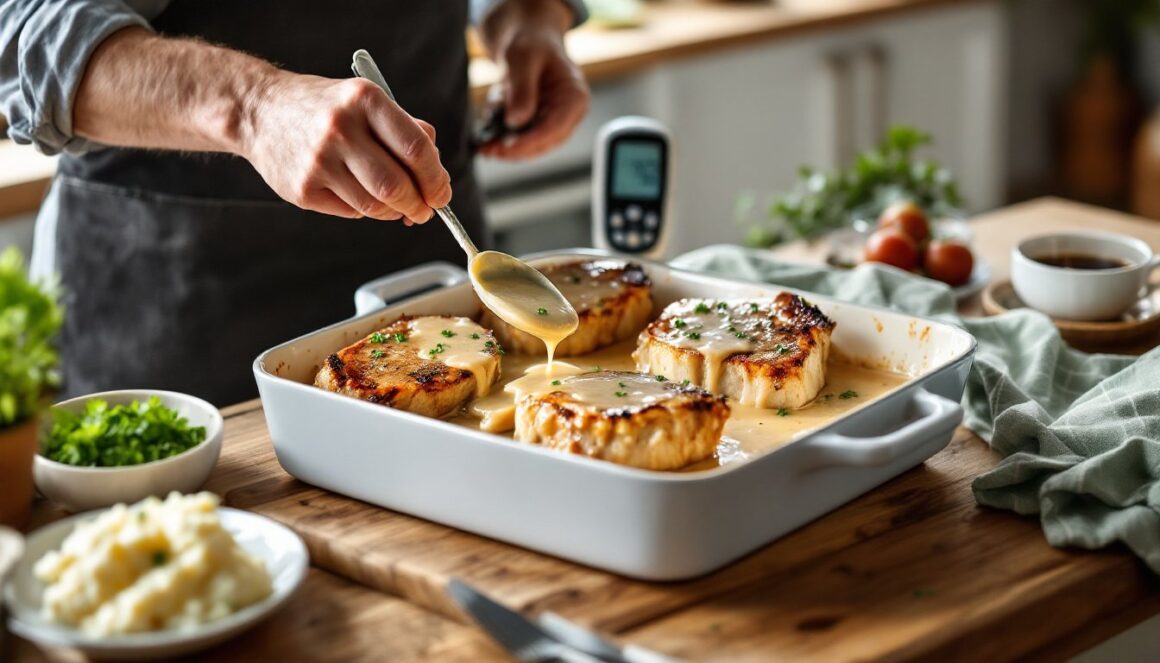
Oven-baked pork chops in sauce, kotletter i sås i ugn, are the kind of no-fuss dinner that feels like comfort food but doesn’t demand babysitting. Slow baking pork chops in a cream-based sauce keeps the meat moist while the sauce reduces into a gravy-like coating. This guide explains why the method works, lists the practical tools and ingredients, walks through a clear step-by-step bake, covers timing and doneness checks, and finishes with smart make-ahead, storage, and serving tips. It’s written so a confident home cook can get dinner on the table with reliable results.
Key Takeaways
- Oven-baked pork chops in sauce stay moist and tender by slow cooking in a cream-based sauce that also thickens into a rich gravy.
- Use 1–1.5 inch thick bone-in or boneless pork chops and cover them largely with a sauce of cooking cream, broth, Dijon mustard or tomato paste, and umami enhancers for balanced flavor.
- Sealing the baking dish during the initial bake prevents the sauce from reducing too quickly and preserves moisture in the pork chops.
- Check doneness with an instant-read thermometer targeting 145°F (63°C) followed by a 3–5 minute rest to ensure juicy and safely cooked pork.
- For best results, optionally sear chops before baking and finish uncovered to brown and thicken the sauce in the last 10–15 minutes.
- Make-ahead by cooking fully then refrigerating; reheat gently to preserve sauce texture and serve with potatoes, green veggies, or rice for a comforting meal.
Why This Recipe Works And What You’ll Need
Why this method works comes down to moisture and mild, steady heat. When pork chops are partially submerged in a cream or broth-based sauce and baked at a moderate temperature, the liquid protects the exterior from drying out while warm moisture and time let connective tissue relax. That yields tender chops and a sauce that concentrates into a gravy. The technique is forgiving: even thicker bone-in chops do well, and thinner chops cook faster with less time in the oven.
Essential ingredients and notes
- Pork chops: 1–1.5 in (nominal) thick bone-in or boneless chops. (Nominal thickness is what packages list: actual measured thickness can be slightly less.) Bone-in gives more flavor: boneless cooks a little faster.
- Sauce base: 1–2 cups cooking cream, heavy cream, or crème fraîche, plus 1/2–1 cup chicken or pork broth if a thinner sauce is preferred.
- Flavorings: 1 medium onion (sliced), 2 cloves garlic (minced), 1–2 tsp Dijon mustard or 1 tbsp tomato paste for depth, and 1–2 tsp soy sauce or 1 tbsp Worcestershire/HP for umami. Optional heat: ½ tsp sambal oelek or chili flakes.
- Seasoning: Salt and black pepper. Fresh herbs like tarragon (dragon) or thyme finish nicely.
- Thickeners/cheese: A tablespoon of cornstarch mixed with a little water or 50–100 g grated cheese (optional) helps the sauce cling.
Tools and dishware
- Ovenproof baking dish or Dutch oven large enough to hold chops in a single layer, e.g., 9×13 in (23×33 cm) for 4 chops. Cast iron or ceramic works well.
- Skillet (optional) for browning, a 12 in (30 cm) stainless or cast-iron pan.
- Instant-read thermometer to check internal temperature.
- Whisk, tongs, and silicone spatula.
Safety and permits
Cooking pork requires standard kitchen safety rather than permits. Use PPE like oven mitts and cut-resistant gloves if desired while prepping. Always avoid cross-contamination: keep raw pork separate from ready-to-eat items and wash hands, boards, and knives after contact.
Why these ingredient choices
- Cream or crème fraîche adds fat and proteins that produce a silky sauce as it reduces. Cooking cream provides a slightly lighter texture.
- Adding broth or a splash of soy/Worcestershire balances richness and supplies the savory backbone so the sauce doesn’t taste one-note.
This recipe is adaptable: swap mustard for tomato paste for tang, add mushrooms for earthiness, or stir in grated cheese at the end for a richer finish.
Step-By-Step: Oven-Baked Pork Chops In Sauce
This step-by-step workflow assumes four 1–1.5 in chops and a 9×13 in baking dish. It keeps prep simple and uses equipment most home cooks already have.
Ingredients (for 4 chops)
- 4 pork chops, 1–1.5 in thick, bone-in or boneless
- 1 tbsp oil (neutral oil for searing)
- 1 medium onion, sliced
- 2 cloves garlic, minced
- 1–1½ cups cooking cream or heavy cream
- ½ cup chicken or pork broth (optional, for looser sauce)
- 1 tbsp Dijon mustard or tomato paste
- 1–2 tsp soy sauce or 1 tbsp Worcestershire/HP sauce
- Salt and pepper to taste
- 1 tbsp cornstarch mixed with 1 tbsp cold water (optional thickener)
- Fresh herbs for finishing (tarragon, parsley)
Tools
- Ovenproof dish (9×13 in)
- Skillet for optional browning
- Instant-read thermometer
- Whisk and tongs
Instructions
- Preheat the oven to 180°C (355°F). This is a mid-range temperature that balances browning with gentle cooking.
- Pat chops dry and season both sides with salt and pepper. Let them sit at room temperature 15–20 minutes, this improves color and even cooking.
- If desired, heat 1 tbsp oil in a skillet over medium-high heat and briefly sear chops 1–2 minutes per side until golden. Browning is optional but adds flavor through Maillard reaction.
- In the same skillet, reduce heat to medium and sauté sliced onion until translucent, about 4–6 minutes. Add garlic and cook 30–45 seconds until fragrant.
- In a bowl, whisk together cooking cream, broth (if using), Dijon mustard, and soy/Worcestershire sauce. Stir in the sautéed onions and garlic.
- Place chops in the ovenproof dish in a single layer, close but not overlapping. Pour the sauce over so the meat is largely covered: the liquid should come up around the sides of the chops.
- Cover the dish with foil or the lid of the Dutch oven for the first part of baking to prevent the sauce from reducing too quickly.
- Bake according to thickness and chosen method (see timing below). Optionally, uncover for the last 10–15 minutes to thicken and brown the top.
- If sauce needs thickening after baking, transfer a cup of the hot sauce to a small pan, whisk in the cornstarch slurry, simmer 1–2 minutes until glossy, then return it to the baking dish.
- Rest chops 5 minutes before serving so juices redistribute. Finish with fresh herbs.
Notes on technique
- A quick sear is helpful but not required. A skillet gives better crust: a miter or circular-saw-like comparison would be unnecessary in the kitchen, use the tools that make sense for cooking.
- Covering keeps the environment humid and prevents the cream from scorching. Uncovering concentrates flavors late in the bake.
Timing, Temperature, And How To Check Doneness
Timing depends on chop thickness and whether they were browned first. Use an instant-read thermometer for best results: visual cues alone can be misleading.
Common timing approaches
- Short, higher-heat method: 175–200°C (345–390°F) for 15–45 minutes. Use this for thinner chops (under 1 in) or if chops were pre-browned. The higher heat reduces cooking time and helps the sauce caramelize on top.
- Low-and-slow method: 150–185°C (300–365°F) for 1–2 hours. This is ideal for thicker chops or when the goal is fall-off-the-fork tenderness. It’s the technique used in many traditional kotletter i sås i ugn recipes that emphasize a gravy-like finish.
Internal temperature targets
- Safe minimum: pulled from USDA guidance for pork, the recommended safe internal temperature is 145°F (63°C) followed by a 3-minute rest. At 145°F the meat will be just cooked through and still juicy.
- For older or very tough cuts and when a more break-down texture is desired, longer cooking until fibers relax is acceptable, but the internal temp may plateau at roughly the same number while the meat becomes more tender due to collagen breakdown.
How to check doneness
- Use an instant-read thermometer inserted into the thickest part of the chop, avoiding bone. When it reads 145°F (63°C), remove from oven and rest 3–5 minutes.
- Look for clear juices, if juices run pink, cook a bit longer. For bone-in chops, check near the bone for any stubborn pinkness.
- If the sauce looks too thin at pull time, finish covered on the stovetop simmering gently or uncovered in the oven for 8–12 minutes until reduced.
Troubleshooting
- Dry chops: usually from overcooking or starting with very thin chops. Choose thicker chops, reduce oven time, or sear and finish quickly.
- Sauce splitting: high heat or prolonged baking can make dairy separate. Keep temperatures moderate and stir in a bit of broth or a spoon of crème fraîche at the end to smooth it.
Code and safety considerations
- This is non-structural kitchen work, no building codes apply. Food-safety best practices do: keep raw meat <40°F (4°C) in the fridge until ready, and reheat leftovers to piping hot (165°F/74°C).
Make-Ahead, Storage, Reheating, And Serving Suggestions
Make-ahead and storage
- Make-ahead: Pork chops can be fully cooked in the sauce, cooled, and refrigerated. Chops often taste better after flavors meld overnight. Cool within two hours and refrigerate in an airtight container.
- Storage: Store in the fridge for 3–4 days. Freeze for up to 2–3 months: use a freezer-safe container and leave some headspace for expansion.
Reheating
- Oven: Reheat covered at 160°C (325°F) until sauce bubbles and internal temp reaches 165°F (74°C), about 20–30 minutes depending on size and starting temperature.
- Stovetop: Gently rewarm in a covered skillet over low heat, stirring the sauce occasionally to prevent sticking. Add a splash of broth if the sauce is too thick.
- Microwave: OK in a pinch, use medium power and heat in short increments, stirring to avoid hot spots and curdling.
Serving suggestions
- Classic sides: boiled or mashed potatoes, which soak up the sauce well. Roast potatoes also work for texture contrast.
- Lighter options: Steamed green beans, a crisp salad, or sautéd spinach balance the richness.
- Grains: Rice or buttered egg noodles are excellent if the sauce is plentiful.
- Condiments: For a Swedish-inspired touch, serve with lingonberries or a swipe of HP sauce for tang and contrast.
Pairing and plating
- For presentation, spoon extra sauce over the chops and finish with a sprinkle of fresh herbs. If the sauce is very pale, a few drops of lemon or a spoonful of tomato paste can brighten the plate.
Cost and substitutions
- Cost varies by region and cut. Bone-in chops are often less expensive per pound than boneless: shop for sales and consider slicing a pork loin into thick chops if whole chops are pricey.
- Dairy-free alternative: use coconut cream and a splash of chicken broth: reduce to taste and season carefully since coconut carries a strong flavor.
A final practical tip: measure the baking vessel and plan portion sizes so sauce levels are right, too much liquid dilutes flavor, too little risks scorching.
Conclusion
Kotletter i sås i ugn, oven-baked pork chops in a creamy sauce, deliver dependable weeknight satisfaction: moist meat, a comforting sauce, and flexible timing to suit busy schedules. By choosing the right chop thickness, using a cream-plus-broth sauce, monitoring internal temperature (145°F/63°C), and finishing with a brief rest, anyone can serve tender, flavorful pork chops. Make a double batch of sauce, refrigerate, and reheating will produce quick dinners for the week.