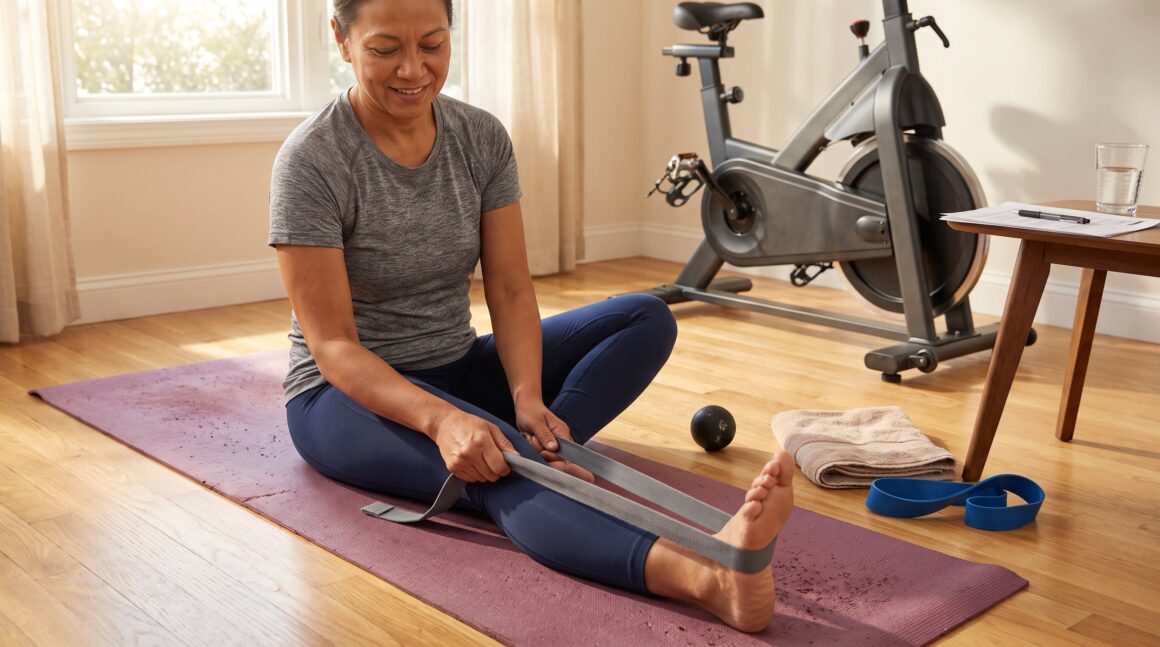
πονος πισω απο το γονατο ασκησεις, this guide explains practical, safe exercise strategies for pain behind the knee. It gives clear causes, urgent red flags, a short self-check to decide if exercise is appropriate, and eight targeted movements. The advice prioritizes safety: stop for swelling, warmth, or sudden instability and seek evaluation. The content is evidence-informed and designed for readers who want step-by-step actions they can try at home or discuss with a clinician.
Key Takeaways
- Pain behind the knee often results from muscle strain, meniscus tears, Baker’s cysts, or overuse of the hamstrings and calves, so accurate diagnosis is essential before starting exercises.
- Safe exercises for πόνος πίσω από το γόνατο ασκήσεις include gentle hamstring stretches, progressive strengthening of the glutes, hamstrings, and calves, and low-impact conditioning like cycling or walking.
- A quick self-assessment can help decide if exercises are appropriate: mild to moderate pain without swelling, locking, or vascular symptoms indicates it is safe to proceed.
- Stop exercises immediately if swelling, warmth, instability, or severe pain occur, and seek urgent medical evaluation for red flags like fever or inability to bear weight.
- Progress exercises slowly by starting with stretching and mobility, then adding strengthening twice a week, and carefully monitor pain to avoid setbacks.
- Consistent, balanced exercise focusing on flexibility, tendon load capacity, and hip control can reduce posterior knee pain and improve function within 4–8 weeks.
Common Causes And Red Flags For Pain Behind The Knee
Fact: Pain behind the knee often comes from muscle or tendon strain, meniscus tears, Baker’s cysts, ligament injury, arthritis, or less commonly a deep vein thrombosis (DVT). Overuse of the hamstrings or calves causes many cases. A Baker’s cyst produces a soft, fluctuant swelling that may increase after activity. Meniscal tears usually cause sharp pain with twisting, sometimes locking. PCL injuries follow a direct force to the front of a bent knee.
Details: Patients with tendon or muscle strain often describe a dull ache that worsens after activity and eases with rest. Arthritis pain behind the knee comes with stiffness and reduced range of motion in older adults. DVT presents differently: look for calf swelling, warmth, redness, and shortness of breath, these are red flags that need immediate medical attention. Other urgent signs include inability to bear weight, sudden severe swelling, fever, deformity, or worsening numbness. If any of those appear, the person should seek urgent care rather than attempt exercises.
Numbers and context: In clinical reviews, overuse injuries and tendinopathy account for a large share of posterior knee complaints, while Baker’s cysts are found in up to 25% of people with underlying knee arthritis on imaging. DVT is less common but critical to rule out when vascular signs appear.
How To Know If Exercises Are Right For You (Quick Self-Assessment)
Answer first: Exercises suit those with mild to moderate pain, no major swelling, and the ability to walk and bear weight normally. They do not suit people with severe pain, locking, giving way, fever, or signs of DVT.
Quick checklist (use it): 1) Can the person walk short distances without the knee buckling? 2) Is the swelling minimal and localized rather than whole-leg? 3) Is there no warmth, redness, or calf pain that spreads? 4) Has the pain developed gradually or after known overuse rather than after a high-impact trauma? If the answer is yes to 1 and 4 and no to 2 and 3, home exercises are reasonable.
Practical warning: If the knee locks, gives way repeatedly, or the person cannot put full weight on the leg, stop and get professional assessment. If there is sudden swelling or vascular signs (warmth, redness, calf swelling), call emergency services. Exercises started too early can worsen meniscal or ligament injuries, so use this self-assessment conservatively and re-check symptoms after two to three days of gentle activity.
Exercises To Reduce Pain Behind The Knee
Key point: A balanced program combines gentle stretching, progressive strengthening, and low-impact conditioning. Start with pain-free ranges, progress slowly, and monitor symptoms daily.
Overview of the eight practical movements included below: 1) gentle hamstring static stretch, 2) hamstring PNF (contract–relax), 3) soft-tissue heel-to-glute release with a lacrosse ball, 4) glute bridges, 5) hip hinge (Romanian deadlift pattern), 6) prone or standing hamstring curls, 7) double- and single-leg calf raises, and 8) low-impact conditioning like cycling or brisk walking. These target posterior chain flexibility, tendon load capacity, hip control, and calf strength.
How to use them: Begin with two to three sets of low-load mobility and stretching daily. Add strengthening twice weekly, increasing load by 5–10% when exercises feel easy for three sessions. Keep conditioning low impact until pain settles: a 10–20 minute cycling session at light resistance is a safe starter. Log pain on a 0–10 scale before and after activity: stop or regress if pain increases by more than 2 points or if swelling appears.
Hamstring Stretching, PNF, And Soft-Tissue Release
Fact: Tight hamstrings frequently contribute to posterior knee pain by increasing tension behind the joint. Stretching reduces tension and improves movement control.
Exact steps: 1) Static hamstring stretch, sit with one leg extended, knee soft, and reach toward the toes until a gentle stretch is felt. Hold 20–30 seconds, repeat three times. 2) PNF contract–relax, lie on the back, loop a strap around the foot, lift the leg to the point of mild stretch, push the foot into the strap for 5–7 seconds, then relax and gently increase the stretch: repeat 3 times. 3) Soft-tissue release, use a firm ball 5–10 cm behind the knee and move the ball with light pressure along tender spots for 60–90 seconds: stop if swelling or sharp pain occurs.
Practical details: Perform stretches twice daily. Expect a mild pulling sensation but not sharp pain. Anecdote: a patient who ran 18 miles weekly reported reduced posterior knee tightness after two weeks of daily PNF, cutting his stretching time from 15 to 8 minutes and still gaining flexibility.
Strengthening Exercises: Glute, Hamstring, And Calf Focus
Insight: Strength around the hips and calves reduces load on the posterior knee. Strengthening builds resilience and corrects faulty movement patterns.
Specific exercises and dosage: 1) Glute bridge, lie on the back, knees bent, lift hips until shoulders-to-knees are aligned. Do 3 sets of 10–15 reps. 2) Hip hinge (light Romanian deadlift), use bodyweight or a light dumbbell, hinge from hips with a neutral spine for 3 sets of 8–12 reps. 3) Hamstring curl, prone or standing with light resistance band, 3 sets of 10–15. 4) Heel raises, double-leg progressing to single-leg, 3 sets of 12–20.
Progression and warning: Increase resistance when the final two reps feel manageable. Pause or regress if the person feels a sharp posterior knee pain during a rep. Add single-leg balance work for neuromuscular control once strength is adequate. A realistic goal: regain the ability to climb stairs without pain within 4–8 weeks for most tendinous or muscular causes, with consistent training.
Mobility, Patellar Tracking Work, And Low-Impact Conditioning
Answer upfront: Mobility and tracking exercises improve knee movement and reduce abnormal forces that irritate tissues behind the knee.
Mobility drills: 1) Seated knee flexion/extension, 10–15 controlled reps to restore range of motion. 2) Side-lying hip abduction, 2–3 sets of 12 to support patellar alignment indirectly. 3) Short-arc quad contractions, 10–15 reps to improve control without heavy load.
Patellar tracking and conditioning: Add gentle patellar mobilizations (supervised) if the patella feels stiff. Low-impact aerobic work like cycling or walking 10–20 minutes three to four times weekly supports healing and improves circulation. Avoid running, jumping, or loaded lunges until symptoms fall by at least two points on the pain scale and there is no new swelling. Sensory detail: cycling at a light gear that keeps cadence at 70–90 rpm usually feels like a smooth glide rather than a jarring impact and is well tolerated by most recovering knees.
Vulnerable moment and tip: Some people push too hard on day two and set back progress. If that happens, reduce intensity, return to basic mobility, and consider a clinician review.
Conclusion
Takeaway: πονος πισω απο το γονατο ασκησεις can reduce pain when chosen and progressed carefully. Start with gentle stretching and mobility, add targeted strengthening for glutes, hamstrings, and calves, and use low-impact conditioning. Stop and seek prompt medical care for red flags such as severe swelling, warmth, inability to weight-bear, fever, or breathing problems. When in doubt, a clinician can rule out meniscal, ligamentous, cystic, or vascular causes and tailor a safe rehabilitation plan.