
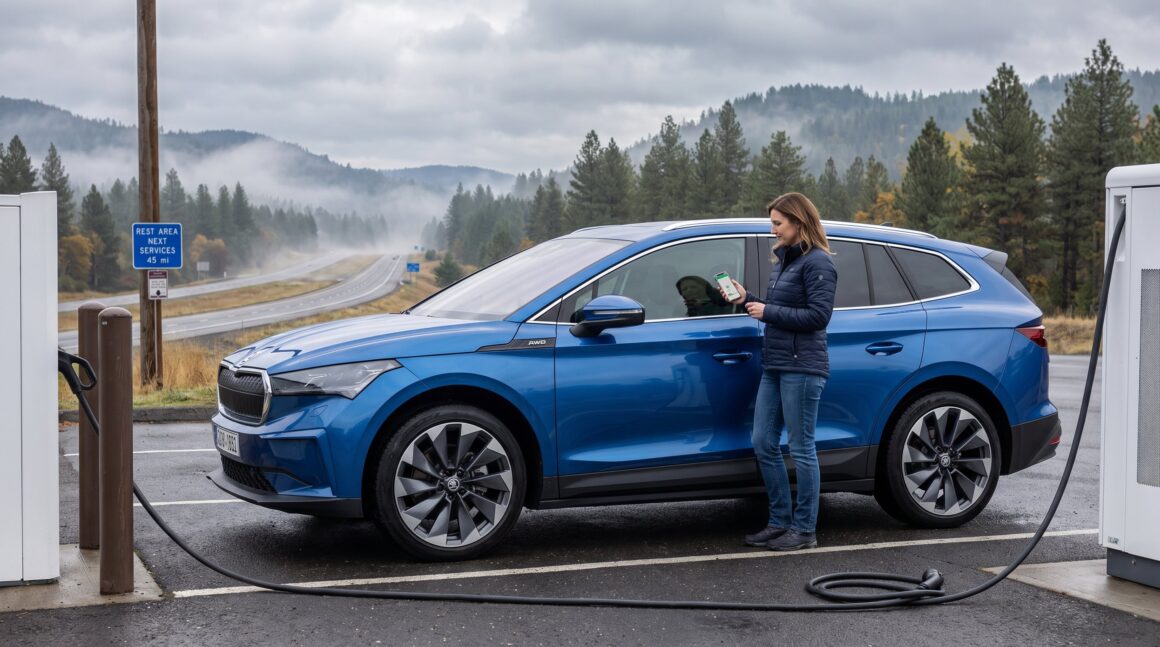
skoda enyaq iv 80x räckvidd: The Enyaq iV 80x typically delivers 300–430 km in everyday use, not the full WLTP number. This guide gives clear, measured figures, explains why numbers vary, and shows practical steps drivers can take to keep the all‑wheel‑drive 80x near its best range. It targets owners and buyers who want realistic expectations and actionable tips rather than glossy lab values.
Key Takeaways
- The Skoda Enyaq iV 80x features a 77 kWh usable battery and AWD dual motors, delivering strong performance but slightly reduced range compared to single-motor models.
- Real-world range for the Enyaq iV 80x typically falls between 300 and 430 km, well below the optimistic WLTP figures of 460–519 km due to driving conditions and usage factors.
- Key factors impacting the Enyaq iV 80x range include ambient temperature, driving speed, extra load, tire type, and HVAC use, with cold weather and high speeds notably reducing range.
- Efficient charging strategy involves fast charging between 10–80% battery state to optimize speed and minimize charge time, while regenerative braking and preconditioning enhance daily range.
- Practical habits like using cruise control, maintaining correct tire pressure, removing unused roof equipment, and preferring heated seats over cabin heating can significantly improve real-world range.
- Drivers should plan trips around 300–400 km in winter and 350–430 km in milder conditions to balance the Enyaq iV 80x’s AWD performance with reliable range expectations.
The Škoda Enyaq iV 80x — Quick Overview And Key Specs
Fact: The Enyaq iV 80x uses a 77 kWh usable battery and dual motors rated at 195 kW, producing 425 Nm.
The Enyaq iV 80x is Škoda’s AWD electric SUV with a usable 77 kWh battery (82 kWh gross). It uses two motors for 195 kW (261 hp) combined, giving a 0–62 mph sprint in 6.9 seconds and a governed top speed of 180 km/h. Charging accepts up to 125 kW on DC fast chargers and up to 11 kW on AC. Those numeric facts set the baseline for range discussion: heavier drivetrain and AWD traction trade some efficiency for grip and performance.
Practical detail: the 125 kW peak will only appear briefly. Real fast‑charge power falls as the battery state of charge rises, so a 10–80% fast charge is the fastest, most efficient window. Owners who expect repeated 125 kW sessions should plan for short bursts rather than sustained high‑power fills.
A candid note: drivers who bought the 80x for sportier feel report slightly higher consumption than single‑motor variants. That difference often shows up as 5–12% lower real‑world range compared with an equivalent rear‑wheel model.
Official WLTP Range Versus Typical Real-World Figures
Fact: WLTP claims put the 80x near 460–519 km, but everyday driving usually yields about 300–430 km.
Official WLTP figures reflect controlled test cycles: they often deliver optimistic numbers for consumers. The 80x’s WLTP range appears around 460–519 km depending on specification, trim, and regional testing. Independent aggregated data and owner reports show a wide spread: EV‑database reports combined mild figures near 490 km and cold combined figures around 360 km. Fleet and green‑car real‑world studies cluster around 426–433 km, while many everyday users report roughly 300–430 km per charge depending on season and use.
Why the gap matters: WLTP does not fully model high‑speed cruising, heavy loads, or prolonged cabin heating. For a family who mostly drives on motorways at 120 km/h in winter, expecting WLTP will lead to range anxiety. A practical planning rule is to budget 65–85% of WLTP for routine trip planning: that gives a realistic safety buffer for unforeseen conditions.
Factors That Most Affect The 80x’s Range
Fact: Temperature, speed, load, tires, and HVAC use cause the biggest swings in real range.
Several concrete factors explain why two identical 80x cars show different ranges on the same day. Ambient temperature affects battery chemistry: at 0–5°C, the usable energy and charging acceptance drop noticeably. Highway speeds increase aerodynamic loss as a square of speed: going from 90 km/h to 120 km/h can cut range by tens of percent. Extra weight, the difference between two adults and a full family plus luggage, can add kilograms that translate directly into higher consumption. Tire choice and wheel diameter change rolling resistance: larger wheels and winter studs reduce range. Finally, cabin heating or heavy HVAC use in cold weather can reduce range by tens of kilometers because the 80x relies heavily on resistive and heat‑pump systems that draw battery energy.
Warning: counting on regenerative braking alone to offset losses is a mistake. Regen helps in city stop‑start driving, but at steady motorway speeds its contribution is minimal.
Weather, Temperature, And Driving Style
Fact: Cold weather can lower real range to around 360 km combined, while mild conditions can push it toward 490 km under gentle driving.
In practical tests, the 80x shows a steep temperature dependence. EV‑database reports combined cold range near 360 km and highway cold around 305 km. At roughly 5°C with sustained 70–75 mph (112–120 km/h), user logs show about 305 km (190 mi) from full to empty. Conversely, in mild conditions and mixed city traffic with calm speeds, combined figures near 490 km are possible.
Driving style matters: gentle throttle inputs, early anticipation of traffic, and smooth acceleration add measurable kilometers. Aggressive launches and hard braking raise consumption quickly. An example: a commuter who shifts from brisk, sporty starts to progressive, two‑second accelerations can see a 6–10% improvement in weekly range, translated into one or two fewer charges per week for a typical user.
Practical tip: use cruise control on open roads and resist the urge to test the 0–62 figure unless range is not a priority for the trip.
Load, Tires, Speed, And Accessories
Fact: Extra weight, larger wheels, and roof equipment directly reduce range: higher sustained speeds cut range the most of all.
Concrete examples: driving at 90 km/h yields ranges often in the 440–485 km band. Raise speed to 120–140 km/h and typical range can drop to the 320–355 km band. Adding a roof box or bike rack at motorway speeds can erase dozens of kilometers because it increases drag. Carrying 100 kg of extra cargo, two full suitcases and a small roof box, translates into a measurable consumption rise that shortens range by several percent.
Tire choice: 19-inch summer low‑rolling resistance tyres typically deliver better range than 21‑inch sporty alloys with high‑grip rubber. Winter tyres with softer compounds increase rolling resistance: plan for reduced range in snowy months.
Accessory caution: cabin heating in subzero weather can cost 20–40 km easily if the battery and cabin are cold. Preheating the car while plugged in reduces that penalty. Heated seats and steering wheel consume less energy than the full cabin heater and are a smart compromise.
Charging Strategy, Regenerative Braking, And Efficiency Tips
Fact: The most efficient fast‑charging strategy is 10–80% at the 80x’s peak power window: regenerative braking and preconditioning are practical range tools.
Best practice: charge between about 10% and 80% when using DC to get faster average kW and less time at the tail end where power tapers. The 80x accepts up to 125 kW but typically only sustains that for a short period. For long trips, plan 10–80% stops and avoid frequent shallow top‑ups if time efficiency is the goal.
Energy recovery: use stronger regenerative braking levels in urban driving to harvest kinetic energy. The Enyaq’s regen can recover meaningful watt‑hours on mixed routes: drivers who maximize regen in city cycles often report several percent better daily range.
Preconditioning: plug in and warm the battery and cabin before leaving on cold days. This practice preserves available range and speeds up DC charging acceptance. A concrete routine: plug in overnight, set departure time, and let the car reach operating temperatures while still on grid power.
Practical habits that add up: maintain tyre pressures to Škoda’s spec, remove roof boxes when unused, use heated seats rather than high cabin setpoints, and keep average trip speeds moderate. These small steps compound into measurable range gains, often tens of kilometers across a week of mixed driving.
Conclusion
Insight: Official WLTP places the Enyaq iV 80x near 480–500 km, but real drivers should plan for 300–430 km depending on conditions. With deliberate charging habits, lower sustained speeds, correct tyres, and smart cabin management, the 80x can approach the upper real‑world figures. Drivers who accept some tradeoffs for AWD performance can still achieve reliable ranges by planning trips around 300–400 km intervals in winter and 350–430 km in milder conditions.