Most B2B websites don’t fail because the product is weak, but because the buyer can’t figure out, fast enough, whether this is the right choice.
Do you know how people actually buy today? And that around 70% of the B2B buying process happens before anyone speaks to sales, which means your site is already part of the decision long before a demo is booked?
Your website design is what will affect visitors’ decisions while they’re comparing, ruling things out, and looking for reasons to trust.
Keep reading to learn how to turn it into something that will help those visitors choose you.
1. Help Buyers Rule You In (or Out)
Too many B2B homepages open with lines that could belong to almost any company.
Statements about growth, innovation, or end-to-end solutions — we’ve all seen it, but these don’t answer the question the reader actually has in mind: why should I look at you instead of the other options on my list?
The best solution here is to be as specific as possible. Your opening message should make three things obvious within seconds:
- Who this is for
- What problem it solves
- Why this option is a better fit than common alternatives
2. Intuitive and Responsive Design That Doesn’t Get in the Way
When people land on your site, they’re trying to understand if you can help them. If they have to fight the layout, zoom in on text, or guess where to click next, they’ll probably leave.
Intuitive design means pages are structured in a way that matches how people scan and read. Key information appears where it’s expected. Navigation feels familiar. Important pages aren’t buried.
Equally important, that same clarity should hold on smaller screens, without shrinking buttons or stacking content in a way that breaks context.
3. Industry-Specific Messaging That Shows You Get Their World
A common mistake on B2B websites is speaking in product language first. Features, platforms, and capabilities take center stage, while the reality of the buyer’s day-to-day work barely shows up.
Strong B2B sites, on the other hand, reflect the pressures of the industry before talking about the solution.
The best way to ensure this is to have dedicated pages for your key industries and include:
- The problems that slow teams down in that field
- The context they operate in
- Use cases that match real workflows
- Proof that uses metrics relevant to that industry
4. Proof That Matches How Buyers Decide
Praise is easy to ignore; evidence isn’t.
Many B2B websites rely on testimonials that sound positive but say very little. “Good team” or “highly recommended” doesn’t help justify a decision.
High-converting sites focus on proof that aligns with real buying criteria. They show outcomes, context, and trade-offs.
Forrester notes that as buying becomes more cautious, product experts and customer success teams are expected to become primary sources of trust by 2026.
In other words, trust is the main “currency” for B2B buyers.
5. Clear Calls to Action for Every Stage of the Decision
Most B2B websites rely on one classic call to action: “Contact sales.” There’s nothing wrong with it, but it only works when a buyer is already convinced.
Your CTAs should match how far along the reader is. Early on, people want information. Midway, they want validation. Only later do they want a conversation.
What works better is offering next steps that feel proportional:
- Educational CTAs for early research (guides or brief explainers)
- Validation CTAs that support internal discussions (case studies or short demos)
- Direct CTAs for buyers who are ready to talk specifics
6. Reduce Decision Friction
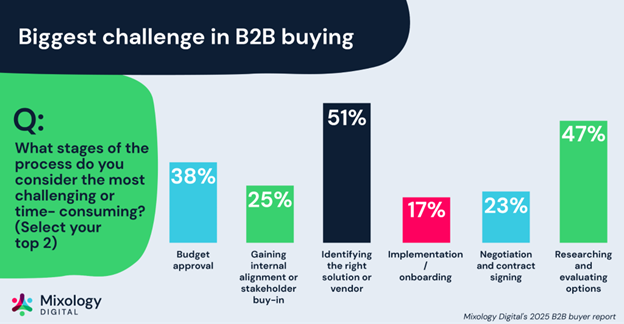
Did you know that 51% of B2B buyers say that finding the right solution or vendor is the most time-consuming part of the buying process?
This is where many B2B websites fail. They assume buyers want more persuasion when what they actually want is less mental work.
Focus on removing uncertainty.
For example, show how different implementation models affect internal workload. Talk openly about what grows smoothly and what becomes harder as teams scale.
It’s important to be honest. If your solution is built for complex setups, say so. Helping someone decide against you builds more trust than trying to win every visitor.
7. Speak to Different Roles
The thing with B2B deals is that one person rarely decides alone.
Check the numbers: 47% of B2B buyers are managers, and 36% are C-suite leaders. They’re all looking for something different.
If your website speaks in one general voice, it ends up connecting with no one.
Structure your content so each role can find what they need:
- Role-based sections that highlight what changes for them
- Language that reflects their priorities, not your feature list
- Proof points matched to the risks they are judged on
8. Offer Content That Helps Buyers Decide
Most B2B buyers want to research on their own before involving sales. They look for explanations, examples, and answers they can trust.
When your website offers shallow or repetitive content, it slows that process down instead of supporting it.
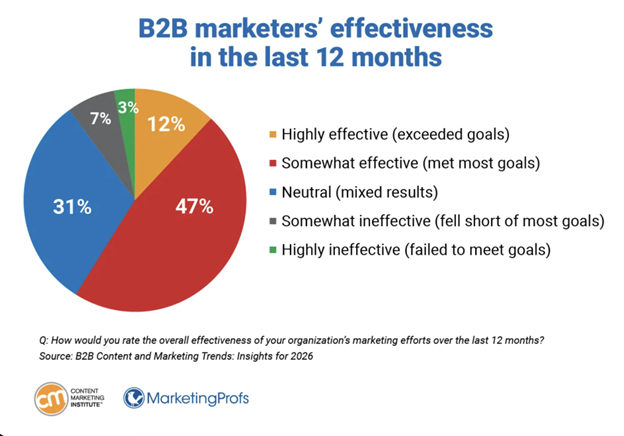
This is where many teams overestimate how well they’re doing. Research shows that only 12% of marketers say their content was highly effective over the last 12 months, while 47% say it was only somewhat effective.
High-performing B2B websites publish content that explains how problems show up in practice, how teams usually approach them, and what trade-offs to expect.
We’re talking case-driven articles, detailed guides, and clear explainers.
9. Show That You Understand What’s Changing in the Industry
Strong B2B websites don’t stop at today’s problems. They also show that you’re paying attention to what’s changing and how that affects the buyer’s next few years.
This means showing awareness of how buying conditions, regulations, technology, or operating models are changing, and what that means in practice.
Buyers want to work with teams that think ahead, not vendors stuck explaining yesterday’s setup.
You can do this by explaining how common processes are now breaking under new demands, or talk about risks companies face if they keep doing things the same way.
Show how your approach supports longer-term stability.
10. Set Up Analytics to See What Buyers Actually Do
You need to set up analytics to see which pages help buyers move forward.
At a basic level, you need visibility into how people arrive on your site and where they spend their time. Traffic sources, entry pages, and drop-off points tell you which messages pull the right audience.
They also show whether visitors from search, email, or paid campaigns behave differently once they land.
When all ten elements work together, your website won’t be a static brochure, but a part of the buying process itself.