

A new role in another city, a growing family, or a deal that hinges on freeing up capital: sometimes a house sale cannot wait. Yet the typical property in England and Wales takes around 115 days to sell, and many sellers sit through as many as 16 viewings before a solid offer arrives.
For a professional juggling deadlines, that timeline is a problem, not a footnote. The good news is that speed is largely within your control once you understand the levers. Here is how the fast track really works.
Key Takeaways
- The average UK home needs about 115 days to find a buyer, but faster routes exist.
- Cash buyers can complete within two weeks, often at around four-fifths of market value.
- Pricing correctly from day one is the biggest driver of a quick sale.
- A valid EPC and early paperwork stop avoidable delays during conveyancing.
- Let your top priority, speed, price or certainty, decide which route you pick.
Why a Fast Sale Matters When Your Time Is Limited
Time is the currency you can least afford to lose during a move. Every extra week a property lingers means more viewings to host, more mental load, and more risk that a buyer walks away or a chain breaks.
When a job move hands you weeks rather than months, learning how to sell your house fast becomes a practical skill, not a luxury. A quick, clean sale frees your attention for the work and the transition that actually pay you.
Selling under pressure also protects your finances. Carrying two properties, or paying a bridging loan while your old home sits unsold, drains cash quickly. The same discipline that keeps a business on track applies here, and it helps to understand the hidden time drains that quietly erode productivity before they swallow your move.
|
Quick context: A fast sale is rarely about panic. It is about choosing certainty and a fixed completion date over the open-ended wait that a traditional listing can become. |
How Long Does a Sale Really Take?
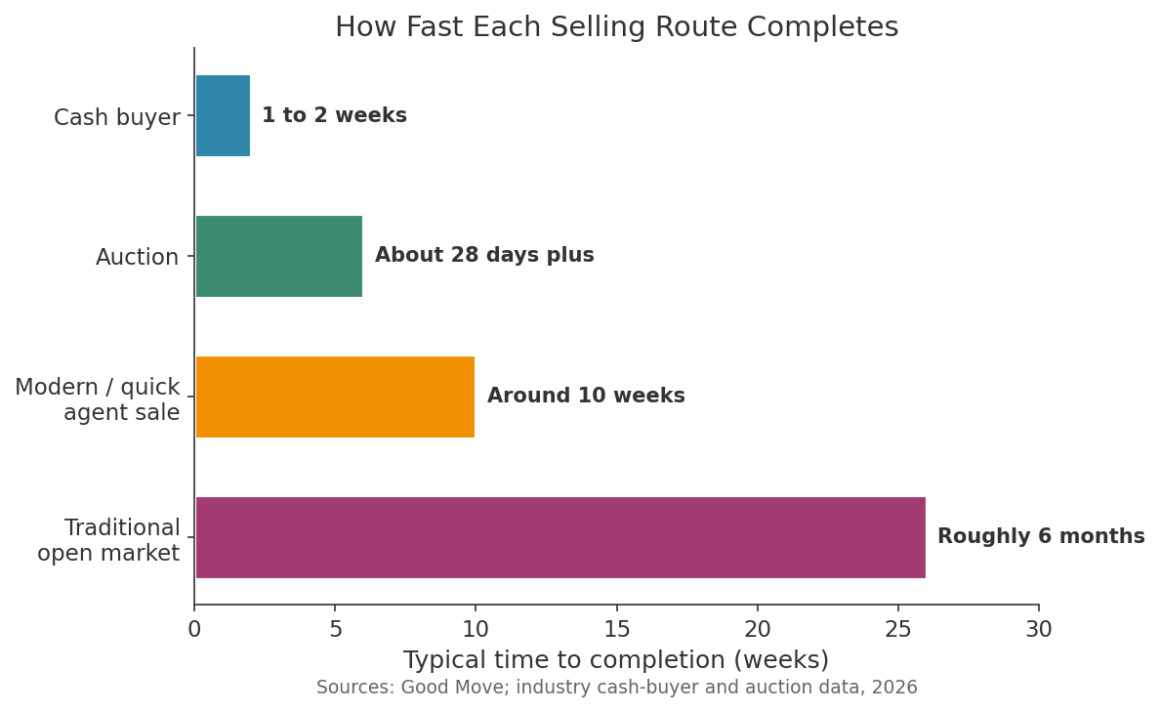
A standard sale here takes about 115 days on average, from listing to a completed transaction, and often longer once conveyancing is included. Cash sales can finish inside two weeks, auctions in roughly 28 days, and a well run modern agent sale in around 10 weeks.
Those numbers hide a lot of variation. Location, property type, price accuracy and the strength of the wider market all shift the timeline. Demand also moves with interest rates and the season, which is one reason the property landscape keeps evolving.
For a broader view of where housing demand is heading, this look at how the shared living economy is reshaping urban property is a useful companion read. Local conditions still decide your personal timeline more than any national average.
The Main Routes to a Quick Sale
Every fast sale is a trade between speed, price and certainty. No single route gives you all three at once, so start by naming the one that matters most to you.
|
Route |
Typical timeline |
Typical price |
Certainty |
|
Cash buyer |
1 to 2 weeks |
75 to 85% of value |
High |
|
Auction |
About 28 days plus |
Variable, can reach value |
High once sold |
|
Modern agent sale |
Around 10 weeks |
90 to 95% of value |
Medium to high |
|
Open market agent |
Roughly 6 months |
Up to full value |
Medium |
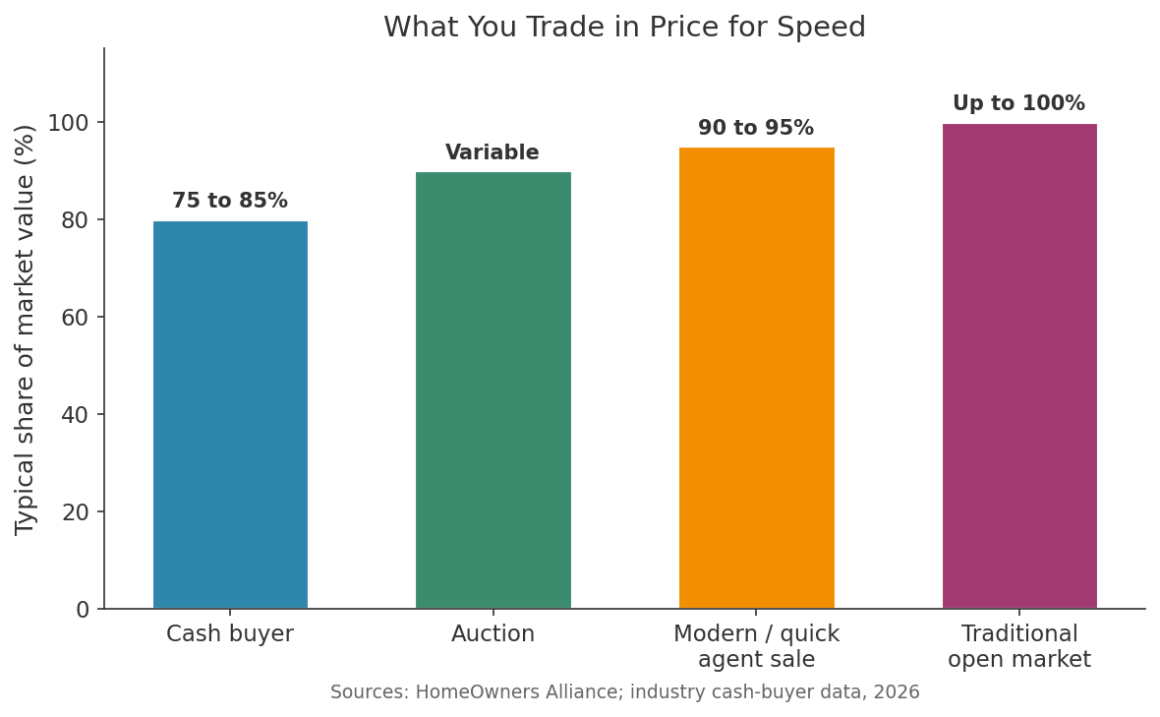
A genuine cash buyer holds their own funds, needs no mortgage and no chain, and can name a completion date to suit you. The trade is price: expect an offer below open market value. Auctions attract investors and can move quickly, though the hammer price is never guaranteed until the day.
|
Watch out: If a buyer promises full market value and a completion in days, be cautious. Ask for written proof of funds and confirm exactly what could change the offer before completion. |
Between the extremes sits the assisted sale, sometimes called the modern method of auction. It aims for a figure nearer the open market while still fixing tight deadlines and reservation agreements that lock a buyer in. For a professional who wants both a fair price and a reliable end date, this middle path often strikes the best balance.
Price and Present Your Home to Sell Faster
Correct pricing is the single strongest lever for a fast sale. Buyers compare dozens of listings in minutes, and an ambitious figure simply pushes yours to the bottom of the pile. Price at or slightly under recent comparable sales and you create competition rather than silence.
Presentation does the rest. Declutter, deep clean, fix the jobs you have been postponing, and lift the light in every room. First impressions online decide whether a viewing ever happens, so strong photography and a clear floor plan earn their keep.
Most buyers judge a listing in seconds, so the photo and the asking price do the heavy lifting long before anyone steps inside.
Buyers reward certainty with money. Chain-free purchasers, who have nothing to sell first, frequently pay a premium for a smooth, predictable completion, which means a quick sale and a strong price are not always at odds.
Responsiveness matters just as much once interest lands. In one client review, a seller praised a “prompt response rate” and an overall smooth experience, the kind of momentum that keeps a motivated buyer from drifting. Quick replies and flexible viewing slots protect a fast timeline.
Video: “How to Sell Your Home: A Step-by-Step Guide for First-Time Sellers in the UK” (Property Cloud TV) | https://www.youtube.com/watch?v=XL0s9t2fvK8
Placement note: embed after the presentation paragraph; the clip walks sellers through pricing, staging and offers.
Sort the Paperwork Early to Avoid Delays
Legal delays, not buyer cold feet, sink most timelines. Getting your documents ready before you list can shave weeks off the process once an offer is agreed.
You must have at least applied for an Energy Performance Certificate before marketing, and it must reach buyers within seven days. Certificates cost roughly £60 to £120 and stay valid for a decade. Confirm your position against the official energy performance certificate rules so an expired one does not stall you.
Common causes of delay are easy to pre-empt once you know them:
|
What slows a sale |
How to fix it early |
|
Missing title deeds or ID |
Gather them before listing |
|
No valid EPC |
Order one as soon as you decide to sell |
|
Slow responses to enquiries |
Reply to your solicitor within 48 hours |
|
Unresolved works or guarantees |
Collect receipts and certificates upfront |
Inherited or probate properties often drive the need for speed, and they carry extra legal steps worth planning for. This piece on why modern estates fall apart and how to rebuild them is a helpful primer. For the full sequence from offer to keys, a detailed homeowner selling guide maps every stage.
|
Pro tip: Instruct your conveyancer the day you list, not when you accept an offer. A solicitor already holding your paperwork can move the instant a buyer appears. |
Frequently Asked Questions
What is the quickest way to sell a home in the UK?
Selling to a genuine cash-buying company is fastest, often completing within a fortnight. You accept a price below market value in exchange for certainty and a guaranteed completion date, with no chain and no mortgage to hold things up.
How much less will I get for a quick sale?
Cash buyers typically pay between 75% and 85% of market value. A modern agent sale or auction can land far closer to full value while still beating the traditional timeline, so weigh the discount against the cost of waiting.
Can I sell quickly and still get a fair price?
Yes. Price sharply from day one, present the home well, and pick a proactive agent or modern auction. Chain-free buyers often pay more for certainty, so speed and a strong figure are not always opposites.
Do I need an EPC to sell fast?
Yes. Order an EPC before you advertise and hand it to buyers inside a week. A valid certificate lasts ten years, so a recent one from an earlier sale may already suffice for your move.
Why do quick sales fall through?
Most collapses trace back to broken chains, slow legal responses or survey surprises. Removing those risks early, through a chain-free buyer and prepared paperwork, is the surest way to protect a tight completion date.
Making the Move on Your Terms
A quick sale rewards clarity. Decide whether speed, a strong price or certainty leads, choose the route that serves it, and prepare the paperwork so nothing stalls once a buyer commits.
Treat the sale like any other project with a deadline: define the goal, remove the bottlenecks, and act early rather than late. Do that and you turn a stressful timeline into a controlled, deliberate move, ready for whatever the next chapter of your career asks of you.