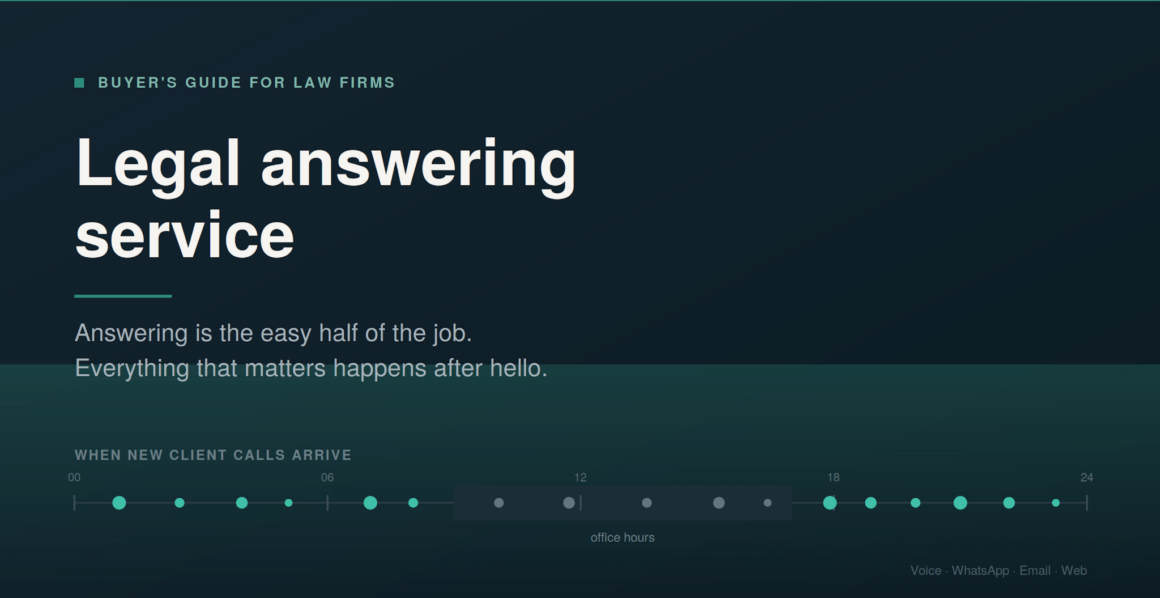
A legal answering service picks up the calls your firm cannot. Every provider below clears that bar. What separates them is what happens in the ninety seconds after the phone is answered, and how you get billed for it.
This comparison covers twelve services across three categories: legal-only human providers, generalist human receptionist companies that serve law firms among others, and AI-first platforms. Pricing was taken from each provider’s own pages at the time of writing rather than from competing roundups, and several publish nothing at all, which is noted where it applies. Confirm current rates before you commit.
How to read this list
Three things determine whether a service pays for itself, and none of them is the headline price.
The billing model. Per-minute billing penalizes thorough intake, because a proper qualification conversation costs more than a rushed one. Per-call billing removes that penalty but scales your bill directly with your marketing spend. Flat platform fees stay predictable and front-load the cost into configuration. Work out your likely monthly total under each model before comparing sticker prices.
Where the service stops. Some answer and relay. Some qualify and book. Some follow up until the client replies. These are different products sharing a category name.
Whether the coverage is real. Several well-regarded providers do not answer around the clock, or route after-hours volume differently. Ask directly.
Legal-only human services
1. Answering Legal
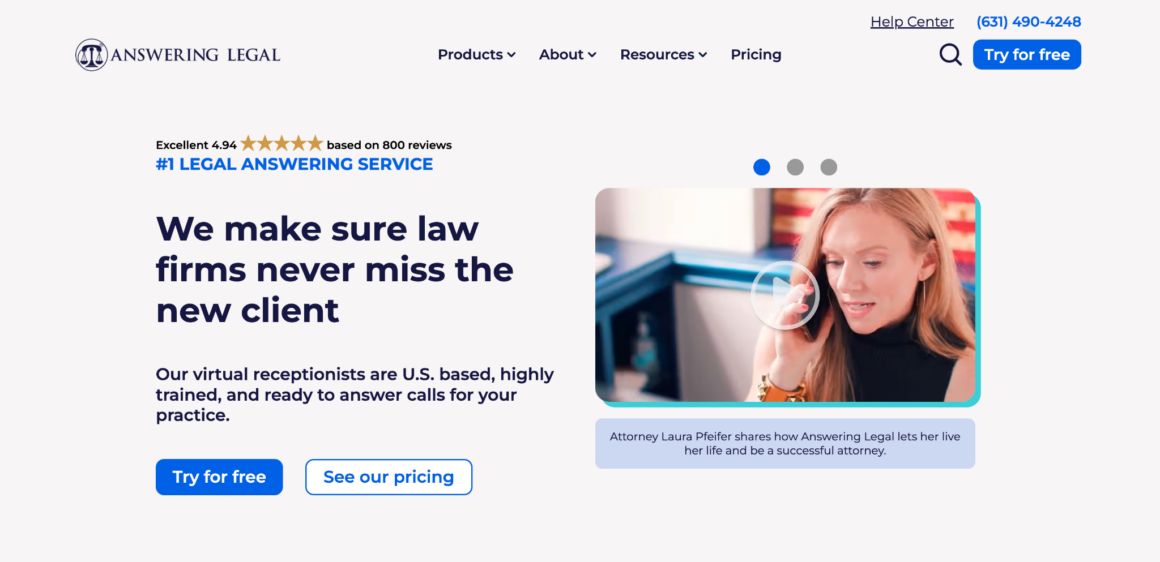
Best for firms that want a provider with no other industries to divide its attention.
Answering Legal has focused exclusively on law firms since 2013 and sells on legal familiarity: receptionists who know what a deposition is and intake scripts written for practice areas rather than adapted from a generic template. Bilingual coverage and 24-hour answering are standard, and the service integrates with common practice management systems.
Pricing is not published. The pricing page routes you to a form or a phone call, and plans are built per firm around minute bundles. There is a free trial period and no long-term commitment, which makes it low-risk to test but hard to compare on paper against providers that publish rates.
Watch for: quote-only pricing means you cannot benchmark until you are already in a sales conversation.
2. LEX Reception
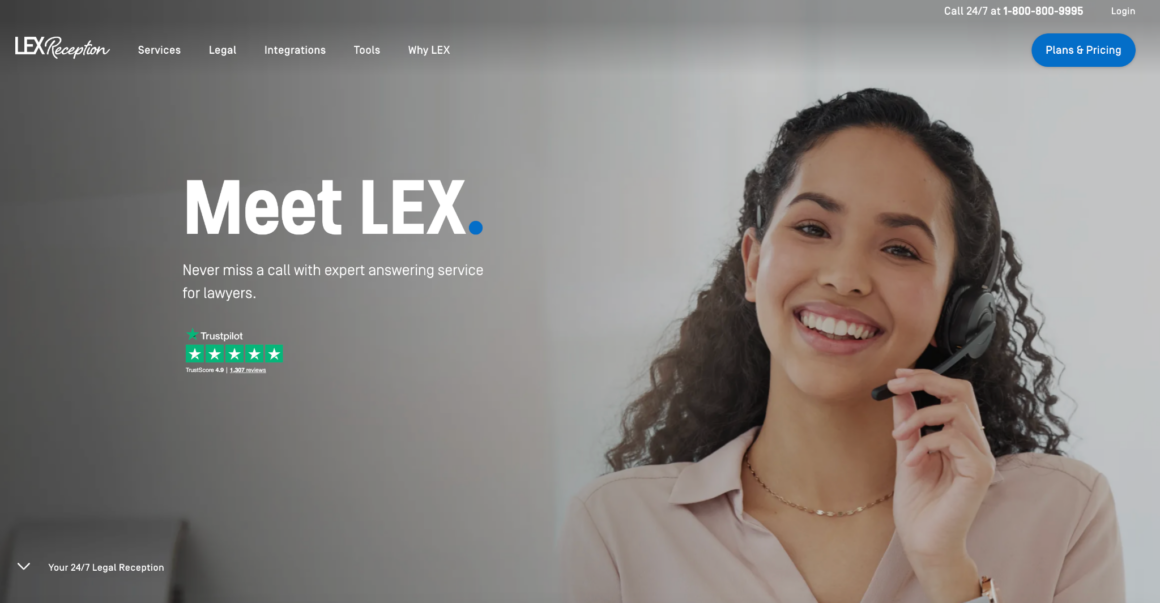
Best for firms that want legal-only reception with a deep bench of practice management integrations.
LEX serves law firms exclusively and positions itself as round-the-clock legal reception rather than an answering service. Beyond inbound calls it offers managed live chat and outbound calling, which matters if you want follow-up handled rather than handed back to your team. Its integration list covers the major legal case management platforms.
Pricing is quote-based and structured around monthly minute bundles with overage rates. Third-party roundups publish figures for LEX, but the company does not, so treat any number you see elsewhere as unconfirmed.
Watch for: per-minute billing rounds up. Ask how increments are counted before signing.
3. Alert Communications
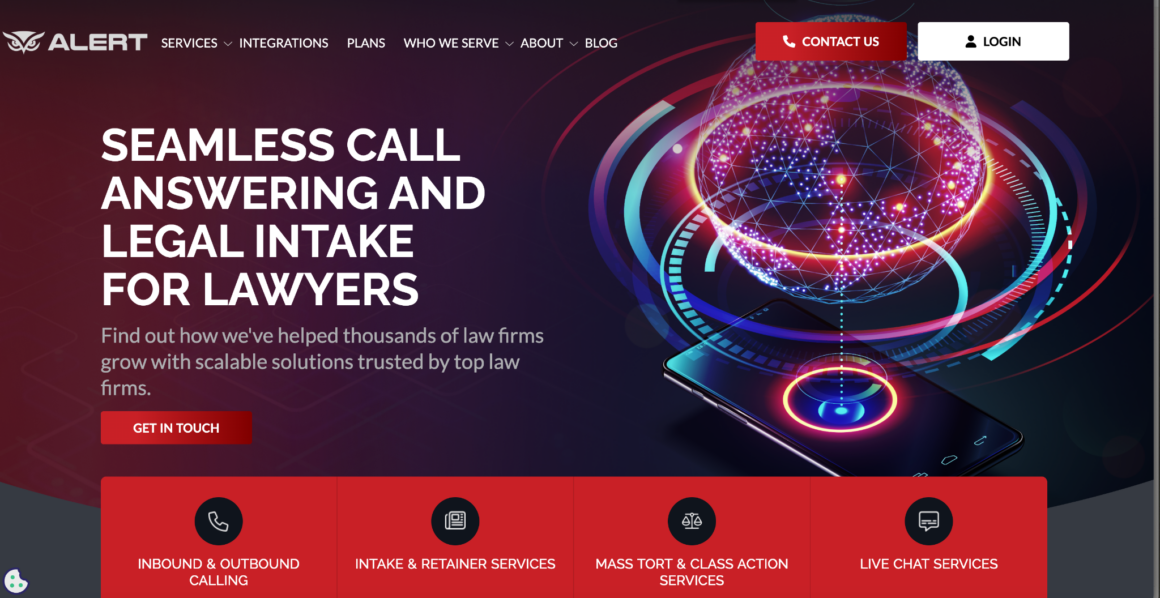
Best for high-volume personal injury and mass tort work.
Alert has run a legal-only call center since 1965 and operates at a scale most competitors do not approach, with a large in-house team covering 24/7/365 in English and Spanish. It handles the full path from first contact to signed retainer, including e-signature and retainer dispatch, and pushes intake data into firm systems through its own API. Mass tort and class action campaign work is a stated specialty.
Pricing is fully custom and not published.
Watch for: capability aimed at firms running paid acquisition at volume. A three-attorney practice may be buying more machinery than it needs.
4. Back Office Betties
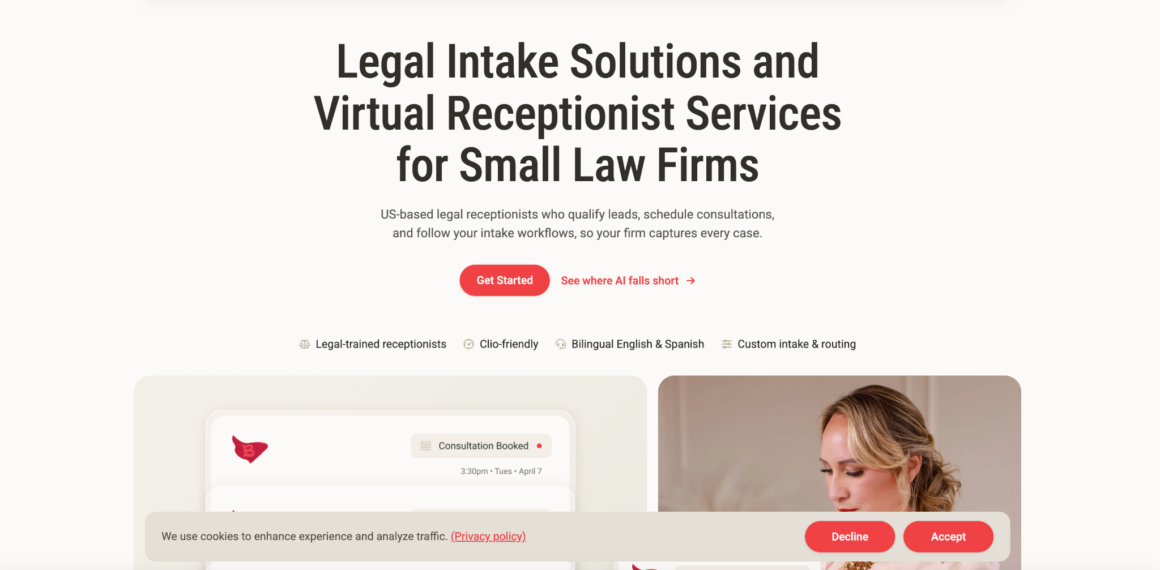
Best for small firms that want a small, familiar, legal-trained team rather than a rotating pool.
Betties assigns each firm a small team of US-based receptionists trained specifically for legal work, and bills real minutes rather than rounding up to the next whole minute, which it makes a point of on its own pricing pages. Bilingual Spanish receptionists are included at no extra cost. Plans are minute-based, and the company also sells virtual legal assistant services for firms that need administrative help beyond reception.
Watch for: the significant one. Their published FAQ puts legal answering service hours at Monday to Friday, 5am to 5pm Pacific. If your requirement is genuine after-hours and weekend coverage, this is not the service for it, whatever else it does well.
AI-first and hybrid platforms
5. Juryo
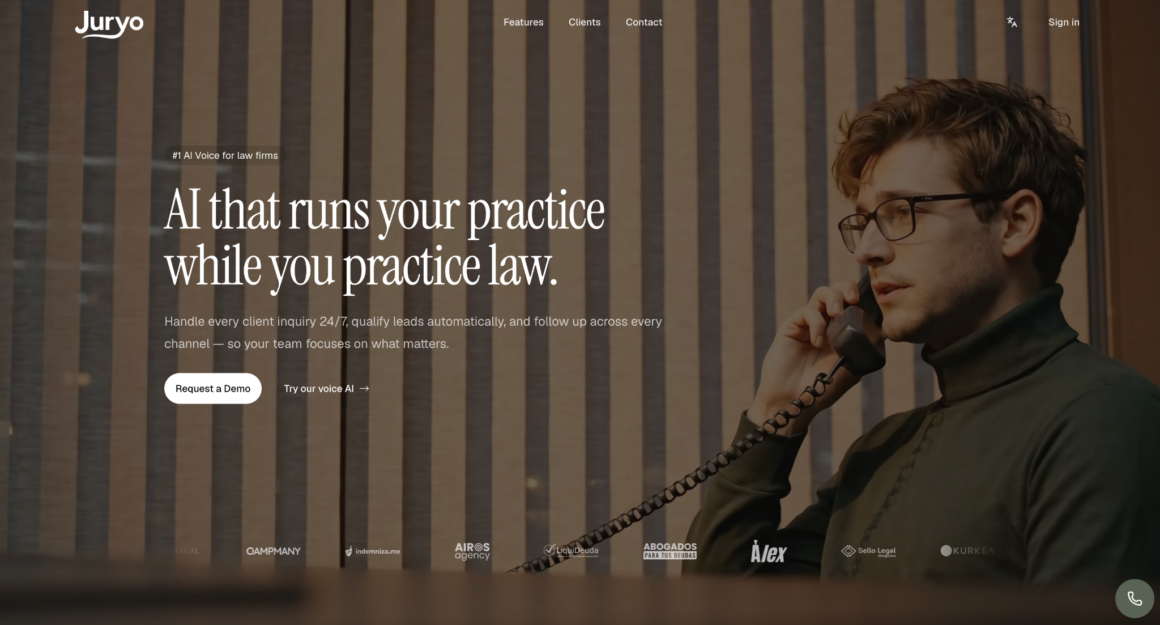
Best for firms that want intake carried all the way to a booked consultation, across more than one channel.
Juryo is an AI agent that answers on voice, WhatsApp, email and web with shared memory across all of them, so a caller who phones on Friday and messages on Saturday continues one conversation rather than starting two. It qualifies against firm-defined criteria per practice area, books the consultation, pushes structured details into the CRM including legacy and custom systems, and follows up rather than returning the lead to your team. Intake runs at full depth in English and Spanish from the same agent. Juryo publishes client references from European firms and works on a flat platform fee rather than per minute or per call.
Watch for: pricing is by demo rather than published, and the client base is concentrated in Europe. Firms wanting a named human voice on every call should look at the human providers above.
6. Smith.ai
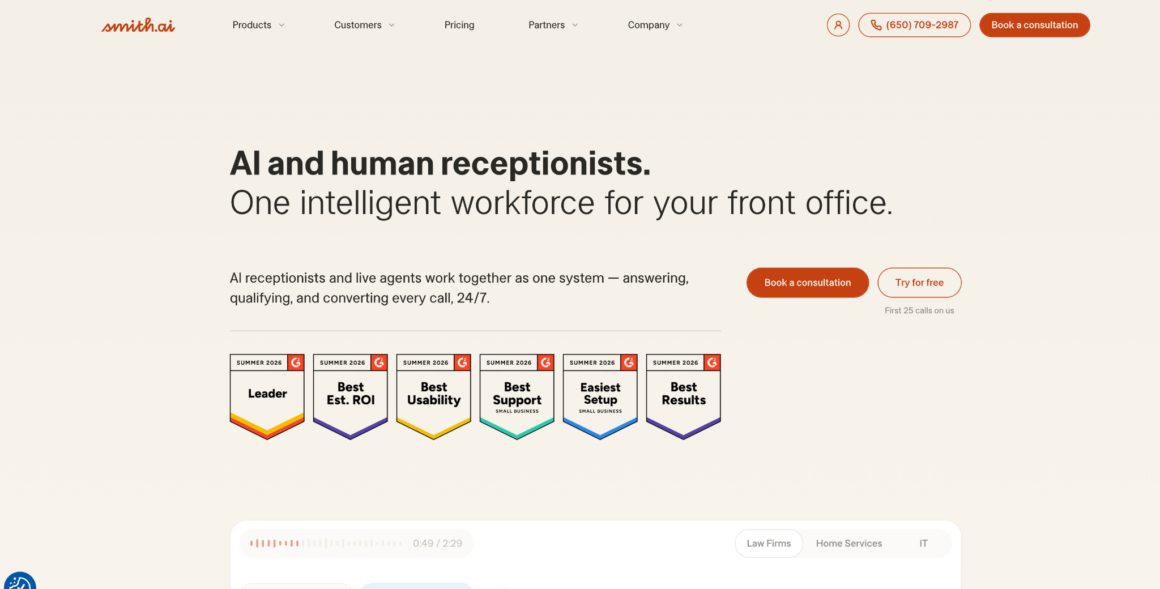
Best for firms that want AI efficiency with human receptionists available for the calls that need them.
Smith.ai routes calls through AI first and escalates to North America-based human receptionists, and it publishes its pricing plainly, which is rarer in this category than it should be. Human receptionist plans run $300 per month for 30 calls, $810 for 90 calls and $2,100 for 300 calls, with overage falling from $11.50 to $8.50 per call as you move up. Lead qualification, basic intake and the first CRM integration are included, and there are no setup fees.
Watch for: the add-on structure. Appointment booking, conflict checks, extended intake, follow-up messages and a dedicated Spanish line are each billed per call on top of the plan. For a firm that wants all of them, the real per-call cost is meaningfully above the headline.
7. Goodcall
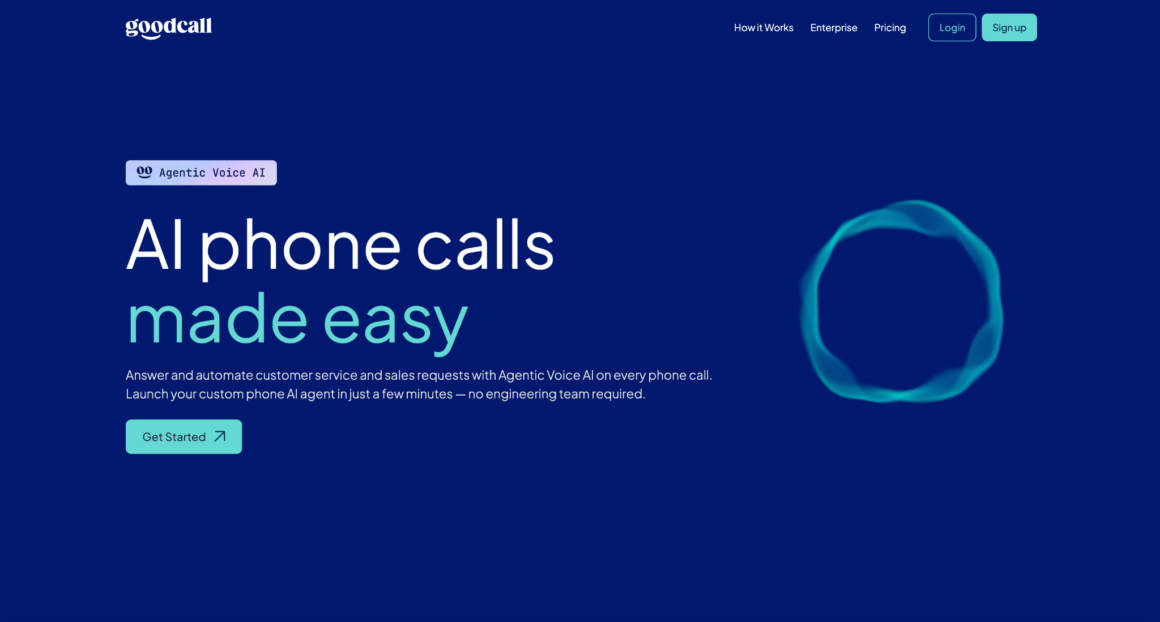
Best for firms that want AI answering with a flat monthly bill and no per-minute meter.
Goodcall sells AI answering with published, flat per-agent tiers based on unique callers rather than minutes, starting at $79 per month and rising through mid tiers as volume grows. Setup is same-day rather than a multi-week onboarding. It handles inbound calls, intake and appointment scheduling.
Watch for: it is a generalist AI product with a legal landing page rather than a legal-specific build. Test the qualification depth against your own practice areas.
Generalist human receptionist services
8. Ruby
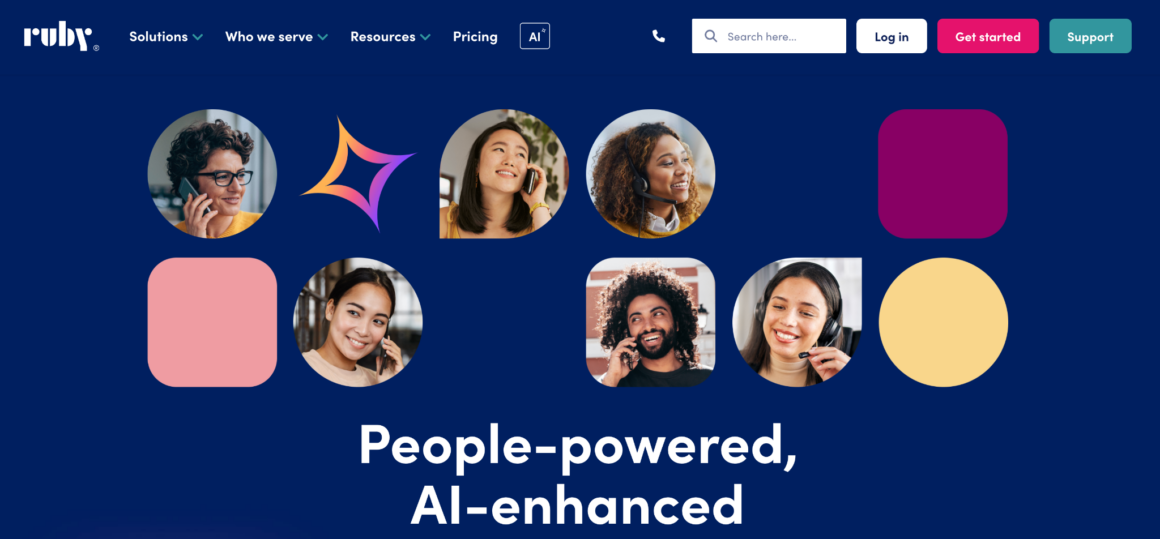
Best for firms where the caller’s first impression is the priority and budget allows for it.
Ruby has two decades of history and a strong reputation for the warmth and consistency of its receptionists. Pricing is published and per-minute: $250 per month for 50 minutes, $395 for 100, $720 for 200 and $1,725 for 500. Notably, features are not tiered. Every plan includes 24/7 answering, bilingual handling, scheduling, lead qualification and intake, payment collection and CRM integration, with no setup or onboarding fees.
Watch for: the per-minute meter. Thorough legal intake takes time, and at these rates a handful of long qualification calls consumes a plan quickly.
9. Abby
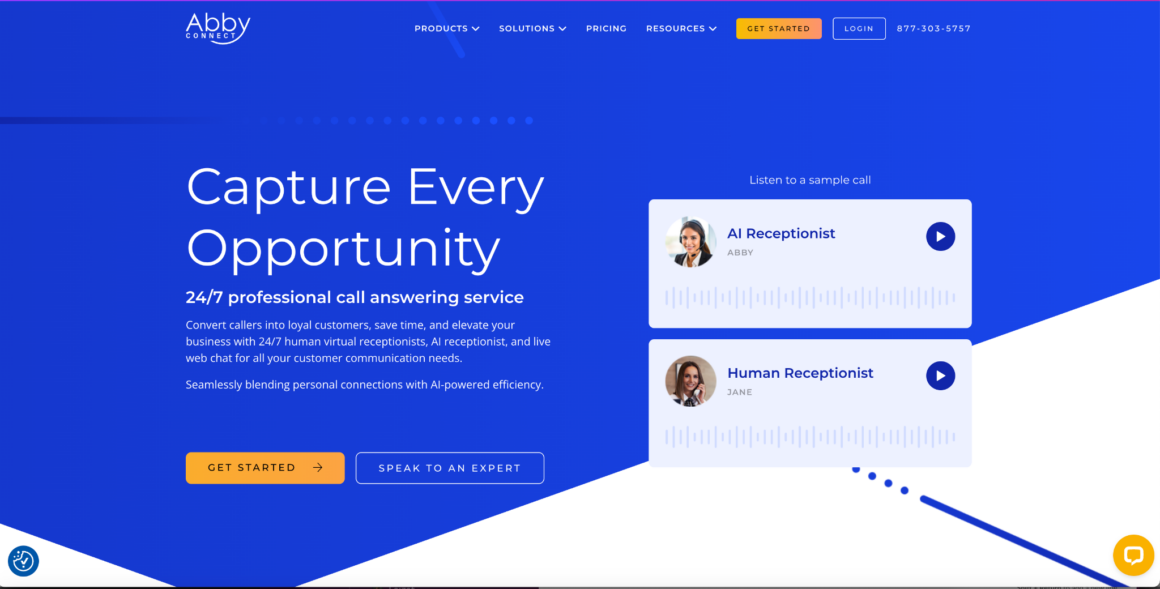
Best for firms that want a named, dedicated team rather than whoever picks up.
Abby assigns each client a small dedicated team of US-based receptionists who learn the account, which is the core of its pitch and a genuine difference from large call-center pools. It bills in 30-second increments rather than rounding to whole minutes, and human receptionist plans start around $329 per month for 100 minutes. An AI receptionist product is available alongside the human service.
Watch for: standard hours are weekday-based, with extended coverage as a paid add-on, and per-minute billing includes ring time on some plans. Ask how spam and hang-ups are counted.
10. Nexa
Best for firms with high call volume that want live agents plus chat and outbound in one place.
Nexa runs a large multi-industry operation with a dedicated legal division, covering 24/7/365 bilingual answering, live chat and text, appointment scheduling, outbound follow-up and lead qualification, with integrations into common legal software. Its scale suits personal injury and other high-volume practices.
Pricing is quote-only. Minute bundles are described but dollar figures are not published.
Watch for: quality consistency at volume. Ask how many firms a given agent pool covers.
11. Moneypenny
Best for established firms that want a premium human service with an AI option alongside.
Moneypenny has supported law firms for over two decades and maintains receptionists dedicated to the legal sector rather than drawn from a general pool. Coverage is 24/7/365, with custom scripting, emergency call processes for urgent matters, managed live chat and a separate AI receptionist product for firms that want to mix the two.
Pricing is not published.
Watch for: the same quote-only comparison problem, plus a premium position that solo practitioners may find hard to justify.
12. PATLive
Best for solo practitioners who want reliable 24/7 human coverage without legal specialization.
PATLive has operated since 1990 with 100% US-based receptionists, 24/7 answering and a 14-day free trial. Its notable structural choice is that call screening, transfers, message taking, lead collection, appointment scheduling and emergency dispatch are included in every plan rather than gated behind add-ons, which is unusual in this market. Billing is per minute across tiered plans.
Watch for: it is not a legal service. Qualification depth, conflict screening and practice-area logic are not what it is built for.
Comparison at a glance
| Service | Type | Billing model | Pricing published |
| Answering Legal | Legal-only human | Minute bundles | No |
| LEX Reception | Legal-only human | Minute bundles | No |
| Alert Communications | Legal-only human | Custom | No |
| Back Office Betties | Legal-only human | Real minutes | Partially |
| Juryo | AI multichannel | Successful Onboarding | No |
| Smith.ai | Hybrid AI and human | Per call plus add-ons | Yes |
| Goodcall | AI | Flat, by unique callers | Yes |
| Ruby | Generalist human | Per minute | Yes |
| Abby | Generalist human | Per 30 seconds | Partially |
| Nexa | Generalist human | Minute bundles | No |
| Moneypenny | Generalist human | Custom | No |
| PATLive | Generalist human | Per minute | Yes |
How to shortlist to three
Start with coverage. If you need genuine nights and weekends, that removes any provider whose standard hours are weekday-only, regardless of how good the reviews are.
Then apply the billing model to your own numbers. Take last month’s inbound call count and a realistic average intake length, then calculate the total under each shortlisted provider rather than comparing entry prices. Per-minute services and per-call services rank differently at 40 calls than at 200.
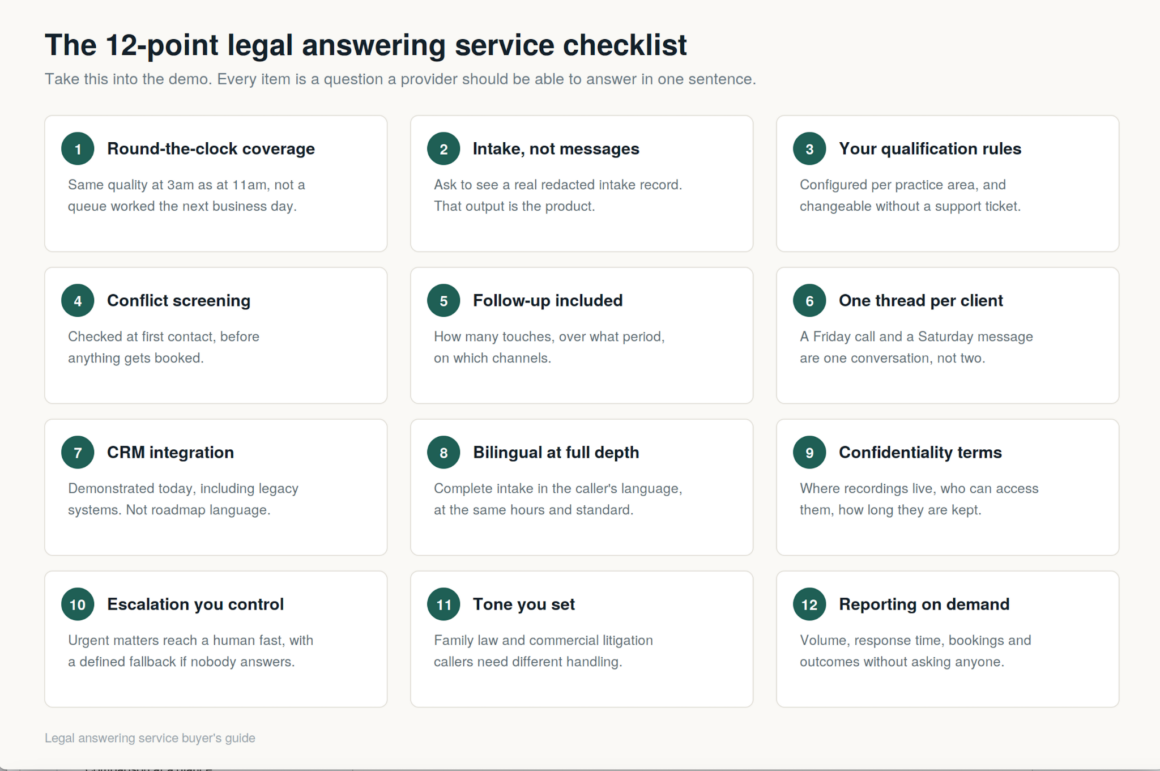
Then ask the one question that separates the category: what happens after the call ends. If the answer is that a message reaches your inbox, you are buying a faster voicemail. If the answer is that the lead is qualified, booked, recorded and followed up, you are buying intake.
Finally, ask each finalist for a redacted sample of what actually lands in the firm’s inbox. That artifact is the product. Everything else is packaging.
The distinction underneath all twelve
An answering service answers and relays. Success is measured in calls covered.
An intake platform carries the lead forward: it qualifies, books the consultation, collects documents and follows up until the person responds. Success is measured in signed matters.
Firms that treat the phone as a cost center buy the first. Firms that treat it as the top of their acquisition funnel buy the second. Work out which one you are shopping for before you compare a single price, because the cheapest service that never books a consultation is not cheap.