
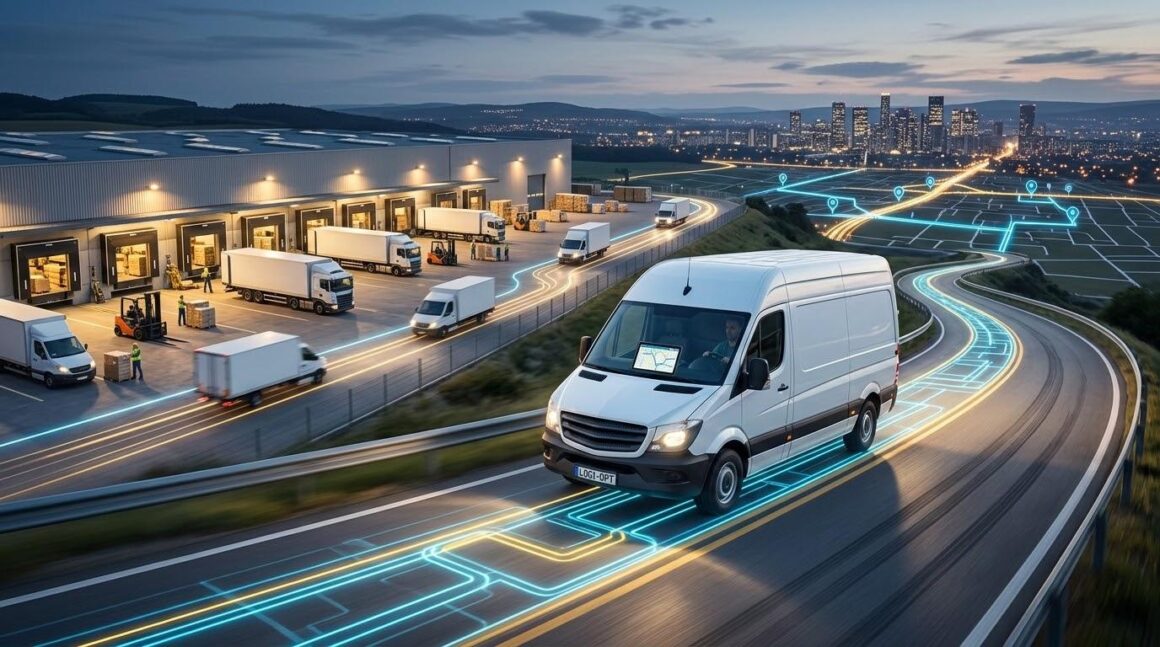
The financial case for route optimization software is usually made in terms of fuel savings and time reduction, and those numbers are real.
Businesses switching from manual planning typically reduce fuel costs by 20 to 30 percent and cut planning time from over an hour to under two minutes.
But if those were the only benefits, the investment decision would already be straightforward and every logistics operation would have made it.
The reason most operations have not is that the gains extend into places that are harder to quantify — customer satisfaction, driver experience, operational resilience — and those are the places where the long-term competitive advantage actually lives.
Fuel savings are the floor, not the ceiling
Fuel is the most visible return because it is directly measurable. When routes are algorithmically optimized, total kilometres driven falls.
When kilometres fall, fuel consumption falls with it.
The reduction is consistent across fleet types and delivery categories because the source of the saving is the same everywhere: routes planned by algorithm are shorter than routes planned manually, because the algorithm can evaluate every permutation and a dispatcher cannot.
The ceiling is harder to name because it is operational capacity, and what you do with recovered capacity depends on what your business needs.
An operation that was running five drivers to exhaustion might run the same volume with four. An operation that was capacity-constrained might take on 20 percent more volume without adding headcount.
The fuel saving is what shows up on the fuel card statement. The capacity recovery is what shows up on the revenue line.
Planning time is management time, and management time has a cost
The dispatcher who spends 90 minutes every morning building routes is not spending that time on exception management, customer issues, or operational improvement.
That time has a salary attached to it, and it is being spent on a task that software completes in under two minutes. The recovered time does not disappear.
It goes into managing the parts of the operation that actually require human judgment — the driver who has a problem mid-route, the customer who needs a delivery changed, the supplier who is running late.
Automating the routine creates capacity for the non-routine, and that is where operations managers tend to have the most impact.
Missed deliveries are a cost centre that rarely gets measured properly
Most logistics operations track their redelivery rate.
Fewer measure the full cost of a missed delivery: the driver time to go back, the fuel for the return trip, the customer service call, the scheduling complexity, the potential churn if it happens twice to the same customer.
The primary driver of missed deliveries is not driver error. It is timing.
Customers who are not home when the driver arrives are not home because they did not have accurate information about when to expect the delivery.
Route optimization software that integrates automated customer notifications solves this at the source.
When the customer receives an SMS telling them their driver is 20 minutes away — and the ETA is accurate because the route is optimized — they are home.
The redelivery that never happened is the saving that never shows up in the data because there is nothing to measure.
Operations that implement this consistently see their redelivery rates fall, and the financial impact is typically larger than expected because the full cost of a missed delivery is usually underestimated.
Real-time visibility changes how operations managers work
An operations manager who does not know where their drivers are cannot manage exceptions until they become problems.
A driver who is running 40 minutes late is managing that situation alone until the customer calls to complain.
A vehicle that is taking an inefficient route has no feedback mechanism until the fuel bill arrives at the end of the month.
Live tracking on a dispatch dashboard changes the operational posture from reactive to proactive.
Problems are visible before they reach the customer.
Adjustments are made in real time. The operations manager is managing the operation rather than cleaning up after it.
Proof of delivery closes disputes before they begin
A delivery dispute — the customer says it did not arrive, the driver says it did — is expensive to resolve and damaging to the customer relationship regardless of how it is resolved.
Digital proof of delivery, a timestamped photo at the delivery address with an e-signature, means the record exists.
The dispute is resolved in minutes rather than days.
More importantly, the record becomes a data source.
Operations managers can see which stops are generating the most delivery issues, identify patterns, and address root causes before they generate more disputes.
Integration reduces error rates that businesses have accepted as normal
Manual data entry between systems produces errors.
The order management platform has the delivery address. Someone types it into the routing software.
A digit is wrong, a suburb is abbreviated differently, a building number is missing. The driver goes to the wrong address.
Nobody intended the error, but it happened because the process requires a human to copy information from one system to another.
Route optimization software that integrates directly with existing systems removes this step entirely. Addresses flow in automatically.
The data that reaches the driver’s app is the same data that exists in the order management system.
Error rates fall not because people become more careful, but because the error-generating step is eliminated. Locate2u’s route optimization software connects to the major ERP and order management platforms and the integration pays for itself in the first month of reduced redelivery and error correction costs alone.